Quick Answer: Companies adapt traditional growth strategies by reordering the classic levers rather than abandoning them: trained capacity before higher prices, fewer and more specific pitches instead of more, one niche instead of a wider service list, and automation of the most time-consuming step under human review. GetMany's analysis of 150,000 proposals, a 90-day platform test and nine agency case studies show each adjustment beating its traditional counterpart.
Kyrylo earned $5M+ through Upwork agencies and $1M+ personally as a freelancer. He served as Community Manager for Upwork's Ukrainian agencies branch and now helps 200+ agencies scale their operations through GetMany.
Most growth advice still follows a playbook written for a slower market: raise prices as demand grows, hire managers as the team grows, move upmarket, add services once the core offer is stable. The playbook is not wrong. It assumes that technology, customer behavior, competition and market conditions change slowly enough to adjust one variable at a time. In service businesses built on digital marketplaces, that assumption stopped holding years ago.
The traditional growth playbook and the world it was built for
In 1957, Igor Ansoff described four ways a company can grow: sell more of the same product to the same market (market penetration), take existing products to new markets (market development), create new products for existing customers (product development), or do both at once (diversification).
For a services company, the four options become a familiar sequence: win more of the same clients, raise rates as reputation grows, hire people and managers to absorb demand, then expand into adjacent services or larger accounts. The sequence works when three conditions hold: acquisition costs are stable, competitors are limited by geography, and producing a proposal costs mostly the founder's time.
Each of those conditions has changed measurably.
Four forces that are rewriting the playbook
Technology: capacity is no longer tied to headcount
McKinsey estimates that generative AI could add between $2.6 trillion and $4.4 trillion to the global economy each year, with about 75 percent of that value in customer operations, marketing and sales, software engineering and R&D. The World Economic Forum's Future of Jobs Report 2025 found that 86 percent of employers expect AI and information processing technologies to transform their business by 2030. PwC's Sizing the Prize research puts AI's potential contribution at $15.7 trillion by 2030.
Tasks that once scaled only with people, such as screening opportunities, drafting proposals and matching work samples to a brief, now run in software with human review. GetMany's comparison of AI-assisted and manual workflows found that manual proposal preparation consumes 25 to 35 hours a week, and that response time to a new job post drops from 4 to 6 hours to under 10 minutes when drafting is automated. Hiring is no longer the first lever to pull.
The same shift raises the compliance bar. Upwork's AI policy permits AI-assisted proposal writing but prohibits fully automated submissions without human review, and the platform's detection systems, which GetMany reviewed alongside documented ban cases, evaluate linguistic patterns, submission timing and behavioral signals. Adaptation means pairing automation with accountability.
Customer behavior: decisions are faster and evidence-driven
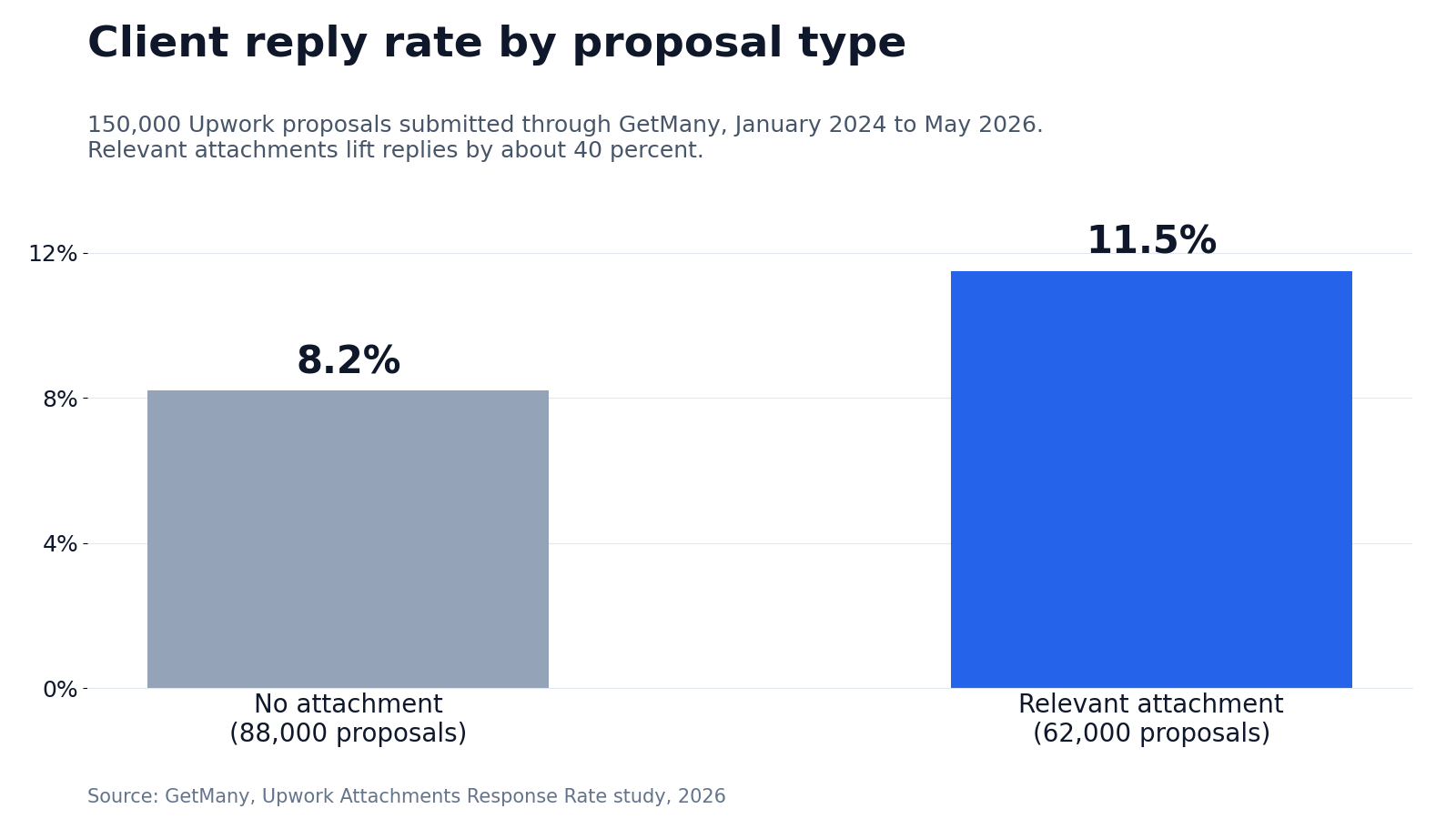
Clients on digital marketplaces make hiring decisions in minutes and reward evidence over volume. GetMany's analysis of 150,000 proposals submitted between January 2024 and May 2026, split into 62,000 with at least one attachment and 88,000 without, found that proposals with relevant attachments received replies 11.5 percent of the time against 8.2 percent, an increase of about 40 percent. Generic brochures performed worse than no attachment at all. An earlier analysis of 50,000 proposals showed the same pattern for length: proposals under 250 characters drew reply rates roughly 30 percent higher.
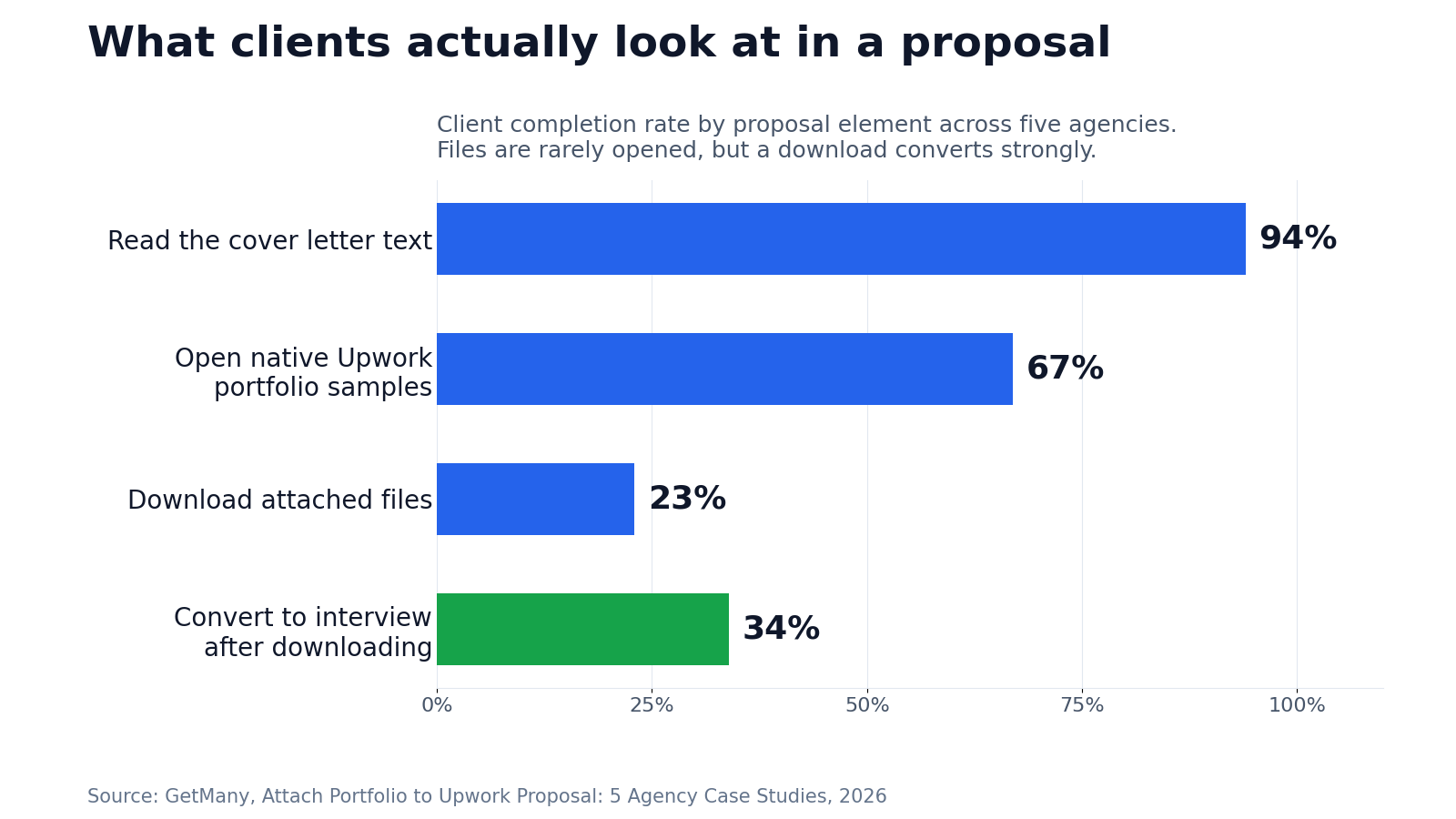
A follow-up study of five agencies explains why. Clients read the cover letter text in 94 percent of cases, open native Upwork portfolio samples 67 percent of the time, and download attached files only 23 percent. When a file was downloaded, conversion to interview jumped to 34 percent. The same study found a trade-off: attachment-free proposals drew replies 95 percent faster but closed projects worth about 40 percent less, while prospects who watched a short video converted at 42 percent. The traditional response to falling reply rates is more proposals. The data points the other way: send fewer, shorter, more specific ones, and put the proof where the client will see it.
Competition: global supply meets algorithmic distribution
Upwork's Freelance Forward research counted 64 million Americans freelancing in 2023, 38 percent of the workforce, and the platform alone lists more than 18 million registered freelancers. It is one of at least fifteen comparable marketplaces GetMany reviewed in its 2026 guide to Upwork alternatives. A company no longer competes with the firms in its city but with every qualified provider the algorithm surfaces. Broad positioning is penalized twice: it lowers the chance of matching a given job and dilutes the profile signals used to rank candidates. Companies that adapt narrow rather than widen: one offer, one niche and one clearly matching portfolio outperform a generalist profile.
Market conditions: the cost of selling has risen
The cost of acquiring a client has also shifted. Upwork's freelancer service fee is now variable, from 0 to 15 percent per contract, clients pay a 3 to 10 percent marketplace fee on top, and each proposal requires Connects, $0.15 each, with 1 to 15 needed per job. Upwork still compares well: GetMany's 90-day test, which sent identical proposals and gigs to Upwork and Fiverr, earned 22 percent more on Upwork, with fee differences alone worth $1,140. Add currency swings, policy changes and, for many teams, geopolitical disruption, and the old volume approach costs more while yielding less. When my co-founder Vitalii and I left Ukraine and started Serverless Team from Lisbon in 2022, the market had not changed, but every assumption about cost structure, location and team had.
What the field data shows: nine agencies, one pattern
Platform data only matters if the pattern repeats in the field. GetMany's published customer stories span agencies from Pakistan and Turkey to Ukraine, and the numbers point one way.
Sigma Square, a web and e-commerce agency from Lahore, closed $6,000 in new contracts in its first pilot month while cutting time spent on Upwork from 8 hours a day to 3 hours a week. BigBull Technologies, based in Karachi, sent 35 percent fewer proposals after replacing a shift-based bidding team, lifted conversion from about 10 to about 17 percent, and now wins 24 to 40 clients a month with under an hour of daily oversight. Applica reduced average application time from more than 21 hours to 16 minutes. OMG Agency sent 462 proposals in its first 30 days and received 201 views and 44 replies. Acceltor cut response time fivefold and reached a 16 percent reply rate. Brandon Archibald cut bidding time by 70 percent and paid $52 per reply against $70 with the previous tool. Vizio AI, a data analytics consultancy from Istanbul, passed $100,000 in Upwork revenue, and Kyivstar.Tech, a Ukrainian IT company built on a client base of 25 million subscribers, adopted AI-assisted bidding for lead generation.
None of these companies grew by raising prices or hiring a bigger sales team. Each removed one bottleneck, measured the result and moved to the next constraint.
How adaptation actually happens: in stages
Companies rarely replace a growth strategy in one move. In my experience, and in the agencies I worked with as Community Manager for Upwork's Ukrainian agencies branch in 2024 and 2025, adaptation follows the logic of kaizen: a bottleneck appears, one variable changes, results are measured, the next bottleneck becomes visible.
Stage one: add capacity instead of raising rates
The textbook move when demand exceeds a founder's time is to raise prices. Running Lambda Team from Dnipro between 2017 and 2022, I did the opposite. Clients who hired me at $45 an hour were introduced to a developer from my team at $30 an hour, with a 14-day trial and a full refund if the pace fell short. The client saved money, the developer gained steady work, and the company kept a $15 hourly margin for coordination, quality control and risk. Multiplied across a team that grew to 75 developers, that decision produced more than $4 million in revenue. The other half was hiring ahead of demand on fixed monthly salaries, so capacity existed before the next contract arrived.
Stage two: narrow the focus and change the pricing model
As the team grew, the constraint moved from capacity to acquisition and margin. The response was to give every profile a single niche, skip work that did not fit (below the minimum rate, fixed-price scopes prone to overruns, clients paying in exposure), and move long-standing hourly clients to weekly retainers after about three months. Retainers gave clients predictable costs and priority access, and the team predictable revenue without time-tracking overhead. The math is laid out in our 2026 breakdown of whether Upwork is still worth it.
Stage three: automate the bottleneck, then productize it
By the time I was reviewing more than 200 job posts a day and writing near-identical proposals, the bottleneck was attention, not people. We built internal tooling to score jobs, filter them and draft proposals for human review. It became GetMany, now used by more than 200 agencies, and in 2026 extended into a Model Context Protocol server that lets AI assistants such as Claude work with Upwork data directly. GetMany's comparison of the four Upwork MCP implementations found that structured tooling cuts proposal preparation from 45 to 60 minutes to 5 to 10, with a person still approving every submission. The same approach carried into Serverless Team, which earned more than $1 million in its first year in Lisbon. The order matters: fundamentals first, then automation of the step that hurts most, and a product only if the pain turns out to be shared.
A framework: match the signal to the response
| Signal | Traditional response | Adapted response |
|---|---|---|
| Demand exceeds the founder's capacity | Raise rates | Route work to trained capacity at a lower rate, keep a coordination margin |
| Reply rates fall | Send more proposals | Send fewer, shorter proposals with relevant proof attached |
| Margins compress | Move upmarket to bigger clients | Shift established clients to retainers; decline fixed-price and exposure deals |
| Cost per pitch rises | Cut acquisition spend | Filter opportunities with data and automate drafting under human review |
| Competition broadens | Widen the service list | Narrow to one niche per offer or profile |
Frequently Asked Questions About Adapting Growth Strategies
What are the four main strategies for business growth?
Ansoff's matrix defines them as market penetration, market development, product development and diversification. Most service businesses start with penetration and move to product development, which today often means productizing an internal process.
Do traditional growth strategies still work?
Yes, but the order and the triggers have changed. Raising rates, hiring and moving upmarket remain valid. The adaptation is to let data on capacity, reply rates and margins decide when to use each.
How should a small company adapt its growth strategy?
Start with one clearly measurable bottleneck. Change one variable, such as proposal length, niche focus or pricing model, measure the effect over a few weeks, then move to the next constraint. Automate the step that consumes the most time, and keep a person accountable for every client-facing output.
Conclusion
Traditional growth strategies were designed for a world where one thing changed at a time. Today technology, customer behavior, competition and market conditions move together, and the companies that grow treat strategy as a sequence of measured adjustments rather than a fixed plan. The evidence from 150,000 proposals, a 90-day platform test and nine customer stories matches the evidence from two agencies built five years apart: capacity before price, relevance before volume, focus before expansion, and automation only after the fundamentals are firmly in place.
Sources
- Ansoff, H. I. (1957). Strategies for Diversification. Harvard Business Review.
- McKinsey & Company (2023). The Economic Potential of Generative AI: The Next Productivity Frontier.
- World Economic Forum (2025). The Future of Jobs Report 2025.
- PwC (2017). Sizing the Prize: What's the Real Value of AI for Your Business and How Can You Capitalise?
- GetMany (2026). Upwork Attachments Response Rate: Data from 150,000+ Proposals. getmany.com/blog/upwork-attachments-response-rate
- GetMany (2026). Attach Portfolio to Upwork Proposal: 5 Agency Case Studies. getmany.com/blog/upwork-attach-portfolio-to-proposal
- GetMany (2026). Upwork vs Fiverr: 90-Day Agency Test. getmany.com/blog/upwork-vs-fiverr
- GetMany (2026). Upwork AI Agent vs Manual Proposals. getmany.com/blog/upwork-ai-agent-vs-manual-proposals
- GetMany (2026). Upwork AI Policy 2026 and Upwork AI Detection. getmany.com/blog/upwork-ai-policy, getmany.com/blog/upwork-ai-detection
- GetMany (2026). Upwork MCP Server Comparison 2026. getmany.com/blog/upwork-mcp-server-comparison
- GetMany (2026). Upwork Fees and Pricing 2026; Upwork Connects Explained. getmany.com/blog/upwork-fees, getmany.com/blog/upwork-connects
- GetMany. Customer stories: Sigma Square, BigBull Technologies, Applica, Brandon Archibald, Vizio AI, Kyivstar.Tech. getmany.com/customer-stories
- Upwork Research Institute (2023). Freelance Forward 2023.
- Kozak, K. (2024). From $0 to $5M: The Upwork Agency Reality Check. from0to5.com
About the author

Kyrylo Kozak is the founder and CEO of GetMany, an AI-powered platform that helps agencies find and win work on Upwork. He co-founded Lambda Team (2017 to 2022), which grew to 75 developers and more than $4 million in revenue, and Serverless Team, and served as Community Manager for Upwork's Ukrainian agencies branch in 2024 and 2025. The full first-person version of his story is available at from0to5.com.