9 April, 2026

Author
Getmany
How to Win Upwork Jobs: Volume, Quality, and Hybrid Strategies Compared
Landing your first few projects on Upwork feels like breaking through a brick wall. You submit proposal after proposal, watching your connect balance dwindle while responses remain at zero. The platform hosts over 18 million registered freelancers competing for the same jobs, and less than 5% of proposals receive replies from clients. Understanding how to win Upwork jobs requires more than generic advice about "being professional" or "showcasing your portfolio." It demands a strategic framework that matches your resources, expertise, and market positioning against proven success patterns that consistently generate responses and conversions.
Why Winning Upwork Jobs Remains Exceptionally Challenging
The Upwork marketplace has evolved into an intensely competitive battleground. Every job posting receives an average of 20-50 proposals within the first 24 hours, with popular categories like web development and content writing seeing 80+ submissions for a single project.
The numbers paint a stark picture:
- Only 3-8% of proposals receive client responses
- Average response time to land an interview: 15-30 proposals submitted
- New freelancers spend 2-4 weeks before their first hire
- Top-rated freelancers win 30-40% of jobs they bid on
Client behavior compounds this challenge. Most clients sort proposals by "relevance" rather than chronological order, meaning Upwork's algorithm determines visibility before human eyes ever see your pitch. The platform prioritizes freelancers with established success rates, relevant job history, and quick response times.
Beyond algorithmic barriers, human psychology creates additional friction. Research on Upwork success patterns shows that clients typically review only the first 10-15 proposals before making interview decisions. Your submission must break through both technological filters and attention scarcity to generate responses.
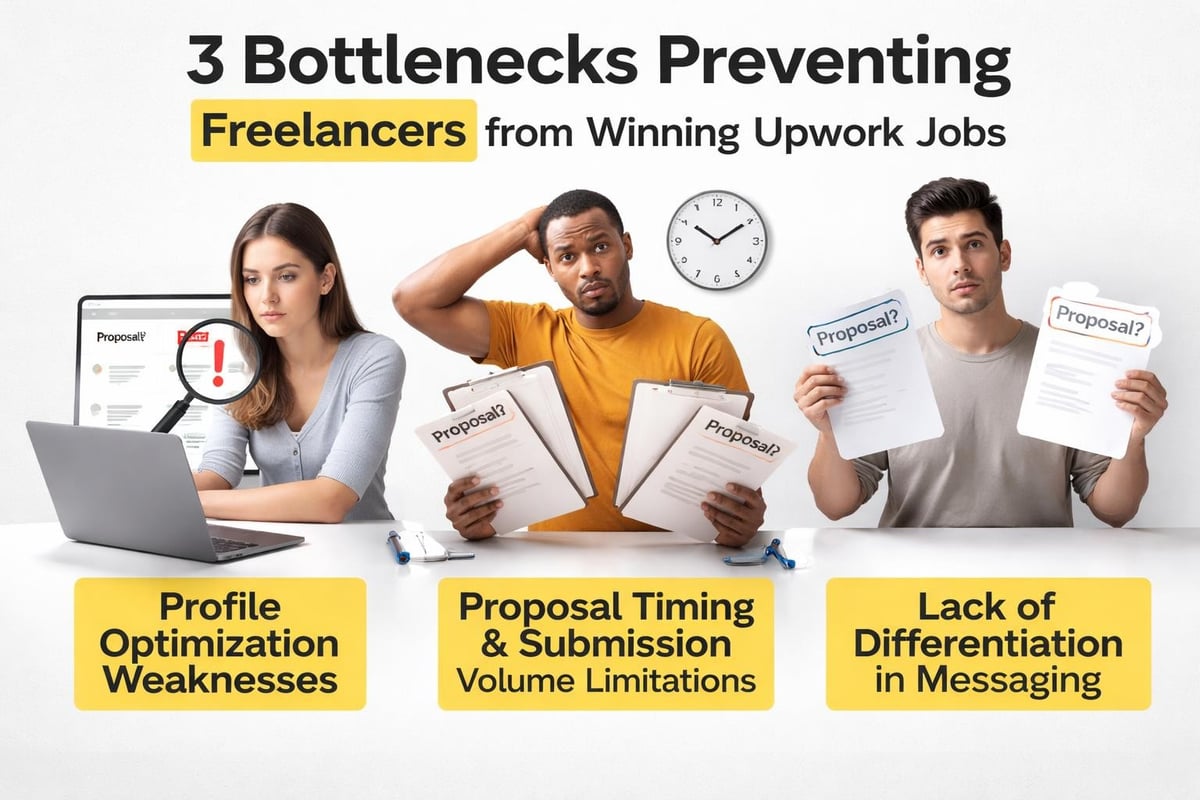
The Three Core Bottlenecks
Profile optimization gaps represent the first barrier. Freelancers with incomplete profiles, generic descriptions, or poorly selected portfolio pieces reduce their response rates by 60-70% compared to optimized competitors.
Proposal timing and volume create the second obstacle. Jobs posted within the last 2 hours receive 75% of all interviews, yet most freelancers submit only 3-5 proposals daily, missing critical time windows.
Differentiation failures form the third bottleneck. Generic proposals using template language and failing to address specific client pain points get ignored even when they arrive early.
Comparing the Three Primary Strategies to Get Hired on Upwork
Successful agencies and freelancers employ distinctly different approaches based on their positioning, resources, and target markets. Understanding these strategic frameworks helps you choose the methodology that aligns with your situation rather than randomly testing tactics.
Volume Strategy: Speed and Scale as Competitive Advantage
The volume approach prioritizes submission quantity and response speed over deep personalization. Freelancers using this strategy submit 20-50 proposals daily, targeting jobs where they meet 70-80% of requirements rather than waiting for perfect matches.
Core principles:
- Submit proposals within 5-15 minutes of job posting
- Use modular templates with 20-30% customization per proposal
- Target job volume over individual project value
- Accept lower initial rates to build portfolio and ratings
| Advantages | Disadvantages | Best For |
|---|---|---|
| High interview volume (8-15 per week) | Lower individual win rates (5-12%) | New freelancers building portfolios |
| Quick market feedback and learning | Generic perception from clients | Competitive commodity services |
| Faster path to first earnings | Connect cost inefficiency | Teams with proposal capacity |
| Algorithm favorability from activity | Burnout from rejection volume | Price-competitive positioning |
This strategy works particularly well for standardized services where differentiation comes primarily from price, speed, and reliability rather than unique methodology. Virtual assistants, data entry specialists, and basic graphic design services often succeed with volume approaches.
Implementation requirements include template libraries organized by job category, rapid job-scanning processes to identify quick matches, and systems to track which template variations perform best. Most successful volume practitioners spend 2-3 hours daily just on proposal submission.
Quality Strategy: Deep Personalization and Premium Positioning
The quality strategy takes the opposite approach, submitting only 3-8 highly customized proposals weekly to jobs representing ideal client profiles. Each proposal requires 30-60 minutes of research, customization, and value demonstration.
Freelancers using this methodology typically charge 30-50% above market rates and target clients who value expertise over cost. The proposal itself becomes a demonstration of thinking, problem-solving ability, and strategic insight.
Key characteristics:
- Extensive client and competitor research before each proposal
- Custom insights, strategies, or preliminary solutions included
- Portfolio pieces specifically selected or created for each opportunity
- Higher price positioning with detailed value justification
| Advantages | Disadvantages | Best For |
|---|---|---|
| Higher win rates (25-40% on targeted jobs) | Fewer total opportunities pursued | Established experts with credentials |
| Premium pricing and margins | Longer time to first earnings | Specialized or complex services |
| Better client relationships and retention | Requires significant expertise depth | Consultative service models |
| Lower connect waste per hire | Vulnerable to timing/competition issues | High-ticket project focus |
This approach proves most effective for strategy consultants, specialized developers, executive coaches, and other services where client selection and relationship quality matter more than transaction volume. The strategy also works well for freelancers with existing external reputations or credentials.
Success with quality strategies depends on exceptional profile optimization, strong portfolio pieces that demonstrate methodology, and the ability to identify clients who will value and pay for premium expertise. Understanding competition dynamics on Upwork helps position premium services effectively.
Hybrid Strategy: Automation Plus Human Intelligence
The hybrid approach combines submission volume with strategic personalization through intelligent automation tools. This methodology emerged in 2024-2025 as successful agencies sought competitive advantages beyond pure manual effort.
Strategic framework:
- AI tools scan and categorize incoming jobs by fit score and opportunity value
- Automated systems generate base proposals using job-specific data extraction
- Human review adds strategic insights, specific examples, and relationship elements
- High-value opportunities receive full custom treatment while standard jobs get enhanced templates
Agencies using tools like GetMany achieve 30-50 proposals daily while maintaining 8-30% reply rates-compared to the 3-5% industry average. GetMany's Cover Letter Builder uses [[double bracket]] instructions, a system where you write customizable placeholders once and the AI fills them with job-specific details automatically, cutting proposal time from 30-60 minutes down to 5-10 minutes per submission. The automation versus manual work comparison demonstrates how technology handles repetitive elements while preserving human judgment for strategic decisions.
| Hybrid Approach Component | Automated Elements | Human Elements | Time Saved |
|---|---|---|---|
| Job identification | Keyword matching, fit scoring | Final opportunity selection | 3-5 hours/week |
| Research and context | Client history, past jobs, website data | Strategic insight identification | 5-8 hours/week |
| Base proposal creation | Introduction, qualifications, structure | Unique value propositions | 10-15 hours/week |
| Portfolio selection | Relevance matching | Context and presentation | 2-3 hours/week |
| Follow-up sequences | Timing and initial templates | Relationship building | 4-6 hours/week |
This strategy proves most effective for agencies handling multiple freelancers, specialized teams pursuing moderate volume, and individual freelancers willing to invest in tools to scale their operations. The approach requires upfront setup time but delivers sustainable competitive advantages.
Implementation challenges include selecting appropriate automation tools, creating high-quality template libraries, and establishing quality control processes. Successful hybrid operators typically spend 3-4 weeks optimizing their systems before seeing peak performance.

Breaking Down the Components of Upwork Success
Regardless of which overall strategy you choose, certain tactical elements determine success rates across all approaches. These components work synergistically, where weakness in one area undermines strength in others.
Profile Optimization: Your Silent Proposal
Your profile functions as a persistent proposal submitted simultaneously with every bid. Clients review profiles before reading proposals, using them to eliminate obvious mismatches and validate credentials.
Critical profile elements:
- Professional headline: Specific expertise + outcome delivered + years (e.g., "Senior React Developer | 8 Years Building SaaS Products | 95% Client Satisfaction")
- Overview positioning: Problem-focused opening, methodology demonstration, results quantification, personality glimpse
- Portfolio quality: 5-8 highly relevant pieces with context, process explanation, and results achieved
- Skills verification: Tests passed for top 3-5 skills, especially platform-verified ones
- Employment history: Consistency, progression, relevance to current offerings
Freelancers who optimize their profiles see 40-60% higher response rates compared to those with generic or incomplete profiles. The profile also influences algorithmic ranking, with completed profiles receiving preference in client searches.
Proposal Structure: The Science of Client Attention
Winning proposals follow predictable structural patterns that align with how clients actually read submissions. Eye-tracking studies show clients spend 15-45 seconds scanning proposals before deciding to read fully or skip.
Proven proposal architecture:
- Opening hook (2-3 sentences): Demonstrate you read the job description by referencing specific details or challenges
- Relevant credential (1 sentence): Single most impressive qualification that directly matches this need
- Value preview (3-4 sentences): How you would approach this specific project with preliminary insights
- Social proof (2 sentences): Brief relevant result from similar past work
- Next step invitation (1 sentence): Clear call to action for response
The proposal should span 150-250 words for most projects. Longer proposals work only for complex projects explicitly requesting detailed approaches. Master bidding strategies that win proposals by studying successful patterns in your category.
Pricing Strategy: The Signal Quality Problem
Your pricing sends powerful signals about positioning, expertise, and value perception. Clients filter by budget ranges, but they also use price as a quality proxy when evaluating unfamiliar freelancers. Factor in the freelancer service fee (up to 20% on new client relationships) when calculating your target take-home rate.
Pricing approaches by strategy:
- Volume practitioners: Match or slightly undercut median market rates (10-20% below established competitors)
- Quality specialists: Position 30-50% above median, justify through credentials and process
- Hybrid operators: Competitive on standard deliverables, premium on strategic or complex elements
Many successful freelancers use milestone-based pricing rather than hourly rates for project work, as it demonstrates outcome orientation and reduces client risk perception. The first project with a new client might use competitive pricing to establish relationship, with subsequent projects capturing full value.
Speed and Timing: The Early Bird Advantage
Proposal submission timing dramatically impacts visibility and response rates. Jobs receive 60-75% of their total proposals in the first 6 hours, with clients often making interview decisions within 12-24 hours of posting. According to Upwork's own research on freelancer success, response speed is one of the strongest predictors of whether a proposal is read at all.
Timing optimization tactics:
- Set up job alerts for key search terms to notify within 5-10 minutes of posting
- Prioritize jobs posted within the last 1-2 hours during active work sessions
- Submit during client business hours (identify client timezone from profile)
- Front-load proposal activity to Monday-Wednesday when job posting peaks
Speed creates competitive advantage, but only when paired with fast follow-through once clients respond. Winning the proposal race means nothing if a client's reply sits unanswered for hours while a competitor jumps in. GetMany's Auto Reply feature addresses exactly this - when a client responds to your proposal, the system automatically sends a personalized first message within minutes, keeping the lead warm even when you're offline or working with another client. Agencies using Auto Reply maintain response times under 10 minutes, which directly boosts the reply-to-contract conversion rate.
Follow-Up Systems: Converting Interviews to Hires
Most freelancers stop after proposal submission, missing critical conversion opportunities. Strategic follow-up increases interview-to-hire conversion by 25-40% compared to passive approaches.
Effective follow-up framework:
- Initial interview response: Reply within 2-4 hours, answer questions thoroughly, ask clarifying questions
- Value-add follow-up: Send relevant example, article, or insight 24-48 hours after interview if no decision
- Availability reminder: Gentle ping 3-5 days later if still interested: "Wanted to confirm I'm still very interested and available to start immediately if you'd like to move forward."
The key is providing value and demonstrating continued interest without appearing desperate. Clients appreciate persistence that includes substance rather than empty check-ins.
Managing multiple active leads across Upwork conversations creates its own operational challenge. GetMany's Master Inbox consolidates all your Upwork chats into a single view with Kanban-style pipeline tracking - so you can see at a glance which leads are warm, which need a follow-up, and which have gone cold. For agencies managing multiple freelancers, it also enables team collaboration on client communication without switching between accounts, effectively functioning as a lightweight CRM built specifically for Upwork.
Common Losing Strategies That Undermine Success
Understanding what doesn't work proves as valuable as knowing successful approaches. These patterns appear repeatedly among struggling freelancers despite seeming logical on the surface.
The "Spray and Pray" Approach Without Relevance Filtering
Some freelancers misinterpret the volume strategy, submitting to every vaguely related job without assessing genuine fit. This burns through connects rapidly while generating minimal responses because clients immediately recognize generic, irrelevant proposals.
Why it fails: Upwork's algorithm tracks response rates and adjusts visibility accordingly. Consistently low response rates from poor targeting reduce your future proposal visibility, creating a negative spiral.
The Perfection Paralysis of Over-Customization
On the opposite extreme, some freelancers spend 2-3 hours crafting single proposals, submitting only 1-2 weekly while waiting for "perfect" opportunities. This approach rarely generates sufficient pipeline to build sustainable income.
Why it fails: Even with 40-50% win rates on submitted proposals, only 1-2 submissions weekly means 0-1 new clients monthly, insufficient for growth or stability. Perfect proposals to wrong-fit clients generate zero results.
The Race-to-Bottom Pricing Trap
Competing primarily on price attracts the most difficult clients, creates unsustainable economics, and trains the market to devalue your services. New freelancers often start too low and struggle to raise rates later.
Why it fails: Bottom-tier pricing attracts clients who prioritize cost over quality, leading to scope creep, difficult communication, and poor reviews. The damage to reputation and ratings outweighs the short-term earnings.
Template Proposals Without Customization Markers
Using the exact same proposal for every job, even within the same category, creates obvious pattern recognition for clients. Proposals that don't reference specific project details signal mass submission.
Why it fails: Clients specifically watch for personalization as a filtering mechanism. Generic proposals, regardless of quality, get eliminated before serious consideration.
Neglecting Profile Optimization While Focusing Only on Proposals
Many freelancers spend all their energy on individual proposals while maintaining incomplete or outdated profiles, not realizing the profile acts as a multiplier or reducer of proposal effectiveness.
Why it fails: A weak profile can reduce response rates by 50-70% even when proposals are excellent. Clients use profiles to validate proposal claims and eliminate risky hires.

Advanced Frameworks for Sustained Success
Once you've established basic competency, these advanced approaches create sustainable competitive advantages that compound over time.
The Portfolio-First Development Strategy
Rather than waiting for perfect jobs, strategically accept smaller projects that fill portfolio gaps or build specific credentials. This creates demonstration proof for future higher-value opportunities.
Implementation approach:
- Identify your target client profile and their primary concerns
- Audit your portfolio against those concerns
- Accept 2-3 smaller projects that fill critical demonstration gaps
- Document processes, results, and testimonials meticulously
- Use completed work as centerpiece for future proposals in that category
This strategy trades short-term earnings optimization for long-term positioning strength. A $500 project that generates a powerful portfolio piece and testimonial might unlock $5,000-10,000 in future work.
The Niche Authority Positioning
Instead of being a generalist competing against thousands, dominate a specific niche where you can credibly claim top-tier expertise. This dramatically improves both response rates and pricing power.
Niche selection criteria:
- Sufficient job volume (50+ monthly postings minimum)
- Specialized knowledge requirement (not easily commoditized)
- Clear value metrics clients understand
- Alignment with your genuine expertise or interest
Examples include "Shopify conversion optimization for fashion brands," "API integration for healthcare SaaS," or "executive ghostwriting for fintech CEOs." The specificity attracts ideal clients while deterring poor fits.
The Strategic Client Filtering System
Not all interviews are worth pursuing. Experienced freelancers develop screening criteria to identify projects with high success probability versus those likely to generate problems.
| Green Flags | Yellow Flags | Red Flags |
|---|---|---|
| Detailed job description with clear scope | Vague requirements with "we'll figure it out" | No budget set or "depends on proposals" |
| Professional communication and responsiveness | First-time client with unrealistic timeline | Demands work samples before hiring |
| Realistic budget for scope | Budget at low end of range | Multiple revisions to job posting |
| Clear decision-making process | Many questions but slow responses | Comparison shopping focused only on price |
| Existing relationship with platform | New to platform but researched | Negative review history or disputes |
Using these filters to decline interviews for poor-fit opportunities preserves energy for high-probability conversions. This counterintuitive approach of saying "no" to some opportunities actually increases overall success rates.
GetMany's AI Decision Maker automates much of this filtering process. Instead of relying on simple keyword blocklists, you describe your exclusion criteria in plain English - "no trial projects," "requires long-term commitment I can't offer," "budget too low for scope" - and the AI reads each full job description to apply these rules with genuine contextual understanding. Each skipped job includes a reason, so you can refine your criteria over time rather than guessing why you're not seeing the right opportunities.
The Long-Term Client Development Model
The highest-earning Upwork freelancers generate 60-80% of revenue from repeat clients rather than constantly acquiring new ones. This requires strategic relationship building from the first project.
Relationship development tactics:
- Deliver ahead of schedule on initial projects to establish reliability
- Proactively suggest improvements or next phases during projects
- Maintain communication between projects with relevant insights
- Create retainer arrangements for ongoing needs
- Request introductions to colleagues with similar needs
This approach transforms Upwork from a transaction marketplace into a client acquisition channel, where the platform facilitates initial connections that evolve into long-term partnerships.
The Data-Driven Optimization Loop
Systematic tracking and analysis of your proposal performance reveals patterns invisible through casual observation. This enables continuous improvement rather than random testing.
Metrics to track weekly:
- Proposals submitted by category and job type
- Response rate percentage overall and by category
- Interview-to-hire conversion rate
- Average time from submission to response
- Connect cost per hire
- Template variations and performance differences
After 4-6 weeks of consistent tracking, patterns emerge showing which job types, price points, proposal structures, and timing generate best results for your specific positioning. This data guides strategic evolution.
Understanding how different automation tools support these frameworks helps identify which technology investments deliver the highest return for your chosen strategy.
Choosing Your Strategy Based on Current Position
Your ideal approach depends on multiple factors including experience level, financial runway, specialization depth, and available time investment. This decision matrix helps select the right starting strategy.
For New Freelancers (0-10 Jobs Completed)
Recommended approach: Modified volume strategy with quality elements
Start with 15-25 proposals weekly targeting jobs where you meet 80%+ of requirements. Use templates but customize opening paragraphs and include one project-specific insight per proposal. Price at or slightly below market median to overcome the "no track record" barrier.
Key focus areas:
- Complete profile optimization before heavy proposal activity
- Select niche categories rather than applying everywhere
- Prioritize jobs from clients with hiring history and good reviews
- Accept first 2-3 projects even at lower rates to build portfolio
- Document everything for future case studies and testimonials
Time investment: 15-20 hours weekly on Upwork activity. Expected timeline: 3-6 weeks to first hire, 8-12 weeks to consistent monthly income.
For Established Freelancers (10-50 Jobs, Building Reputation)
Recommended approach: Hybrid strategy with increasing specialization
Maintain 10-20 weekly proposals but increase customization depth and begin filtering for better-fit opportunities. Gradually raise rates by 15-25% while improving proposal quality. Consider automation tools for proposal efficiency to maintain volume while improving personalization.
Key focus areas:
- Identify your top-performing categories and double down
- Develop 3-4 case studies from best past projects
- Begin declining poor-fit opportunities
- Test premium pricing on ideal client profiles
- Build repeat business systems with existing clients
Time investment: 10-15 hours weekly on new client acquisition. Expected results: 30-50% income increase within 3-4 months through better clients and pricing.
For Expert Freelancers (50+ Jobs, Top-Rated Status)
Recommended approach: Quality-first strategy with selective volume
Submit only 5-10 highly targeted proposals weekly to premium opportunities, with each receiving significant customization. Price 40-60% above category median and focus on complex, high-value projects. Use your track record as primary differentiator.
Key focus areas:
- Cultivate repeat and referral business as primary revenue source
- Position for retainer arrangements with key clients
- Develop thought leadership content that attracts inbound inquiries
- Consider agency model to scale beyond personal capacity
- Use Upwork selectively for ideal client profiles only
Time investment: 5-8 hours weekly on new client acquisition. Expected results: Higher earnings per hour while working fewer total hours through premium positioning.
Integrating Technology Into Your Winning Strategy
The landscape of how to win Upwork jobs shifted dramatically in 2024-2025 with the maturation of AI-powered proposal tools. Understanding where technology adds value versus where human judgment remains essential creates competitive advantage.
What Automation Handles Effectively
Modern proposal automation excels at high-volume, repetitive elements that consume time without requiring strategic thinking. These systems can analyze job postings, extract key requirements, match them against your experience database, and generate structurally sound base proposals.
Technology advantages:
- Processing 100+ daily job postings to identify best matches
- Extracting client information from profiles and past job history
- Generating personalized opening paragraphs using job-specific details
- Maintaining consistent proposal structure and formatting
- Scheduling optimal submission timing
- Tracking performance metrics automatically
Platforms like GetMany demonstrate how AI can automate 85% of Upwork workflows - from job discovery through proposal generation to analytics - allowing agencies to maintain 30-50 daily proposal volume while preserving human oversight for strategic elements. This efficiency matters most when pursuing the hybrid strategy.
What Still Requires Human Intelligence
Despite technological advancement, certain elements of winning proposals demand human insight, creativity, and strategic thinking that AI cannot replicate effectively.
Critical human contributions:
- Assessing true project fit beyond keyword matching
- Identifying unstated client concerns and addressing them
- Creating unique value propositions specific to each opportunity
- Determining optimal pricing strategy for each situation
- Building authentic relationship elements into communication
- Making judgment calls on which opportunities deserve investment
The most successful Upwork operators in 2026 use technology to handle volume and consistency while focusing human energy on strategic differentiation. This creates sustainable competitive advantages that pure automation or pure manual effort cannot achieve alone.
Building Your Technology Stack
Your optimal tool combination depends on chosen strategy, budget, and technical comfort. Most successful freelancers and agencies use 3-5 specialized tools rather than trying to find one solution for everything.
Essential tool categories:
- Proposal automation: GetMany's Cover Letter Builder (with [[double bracket]] instructions), Boomerang, or custom solutions
- Job monitoring: RSS feeds, Zapier integrations, native Upwork alerts
- Client filtering: GetMany's AI Decision Maker for context-aware exclusion rules
- Lead management: GetMany's Master Inbox for pipeline tracking and team collaboration
- Performance tracking: GetMany Analytics Dashboard, Airtable, custom spreadsheets
- Instant follow-up: GetMany's Auto Reply to respond to client messages within minutes
Start with native Upwork features and free tools, then add paid automation as your volume and earnings justify the investment. Most freelancers should earn $3,000-5,000 monthly before investing in premium automation tools.
Success on Upwork in 2026 requires choosing a strategic approach that matches your resources, expertise, and market positioning rather than randomly testing generic tactics. Whether you pursue volume, quality, or hybrid strategies, consistency and systematic optimization determine results far more than any single proposal technique.
GetMany is an AI Agency Manager used by 300+ agencies worldwide to scale Upwork operations without sacrificing proposal quality. The platform's Cover Letter Builder uses [[double bracket]] instructions to generate personalized proposals in 5-10 minutes (vs. 30-60 minutes manually), Auto Reply keeps every inbound lead warm by responding within minutes even when you're offline, and AI Decision Maker filters out poor-fit jobs automatically - so agencies submit 30-50 daily proposals and achieve 8-30% win rates without the burnout. Ready to scale your Upwork business? Start with GetMany or book a free demo to see the platform in action.