8 April, 2026

Author
Getmany
Upwork AI Agent vs Manual Proposals: What Works for Agencies in 2026
Agencies using an upwork ai agent respond to jobs in under 10 minutes. Manual bidders? They average 4-6 hours per proposal. That's a 36x speed difference that fundamentally changes who wins contracts on the platform. But speed isn't everything. The real question facing 300+ Upwork agencies in 2026 is whether AI automation or human expertise delivers better results, and the answer isn't what most expect.
Why the AI Agent vs Manual Debate Matters Now
Upwork's evolution into AI-powered hiring and work management has changed the competitive landscape. The platform now processes thousands of proposals within minutes of job postings. Agencies that can't match this velocity lose opportunities before they even know jobs exist.
The stakes are measurable. Manual proposal creation costs agencies 25-35 hours weekly. AI agents reduce this to under 5 hours. That's not just time saved, it's revenue unlocked through higher proposal volumes and faster response times.
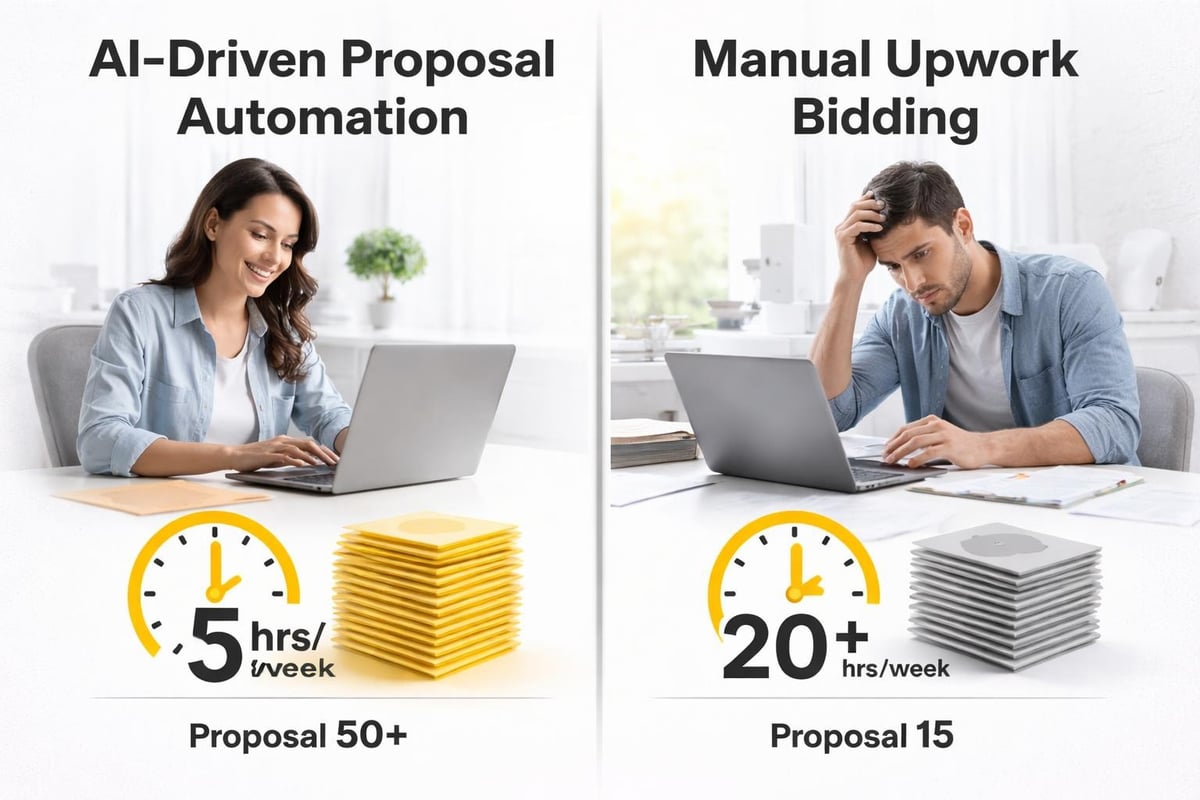
But raw speed creates new questions about quality, compliance, and client relationships. Research from UpBench's evaluation framework shows AI agents excel at certain tasks while struggling with nuanced client communication. Understanding these trade-offs determines competitive advantage.
Speed and Volume: Where AI Agents Dominate
Round-the-Clock Proposal Generation
An upwork ai agent operates 24/7 without breaks, vacation, or sick days. When a project posts at 2 AM, AI responds immediately while competitors sleep. This timing advantage translates directly to higher visibility.
AI agent advantages for speed:
- Response time: 5-10 minutes vs 4-6 hours manual
- Daily proposal capacity: 50+ vs 8-12 manual
- Weekend coverage: Full automation vs reduced manual coverage
- Time zone coverage: Global vs single-region manual teams
Tools like GetMany's Vibe Scan demonstrate this speed advantage by scoring every new job 0-10 based on agency fit and eliminating 80% of irrelevant opportunities automatically. Agencies using this approach maintain 8-30% response rates, significantly above the industry average of 3-5%.
Consistency Across Hundreds of Proposals
Manual bidders experience fatigue. Quality drops after the fifth or sixth proposal of the day. AI agents maintain identical quality standards across their fiftieth proposal as their first.
| Performance Metric | AI Agent | Manual Approach |
|---|---|---|
| Daily proposal volume | 50+ | 8-12 |
| Average response time | 5-10 minutes | 4-6 hours |
| Quality consistency | 95%+ | 70-85% |
| Weekend operation | Full capacity | 20-30% capacity |
| Time per proposal | 5-10 min | 30-60 min |
This consistency matters for automation tools that need predictable outputs across diverse project types.
Personalization and Strategy: Manual's Competitive Edge
Human Insight for Complex Projects
High-value enterprise contracts require nuanced understanding. A $50,000 development project needs strategic thinking that current AI agents struggle to provide. Manual bidders excel at:
- Reading between the lines of vague project descriptions
- Asking clarifying questions that demonstrate expertise
- Tailoring solutions to unstated client pain points
- Building rapport through conversational tone
- Pivoting strategies based on client profile analysis
These capabilities matter most for contracts over $20,000 where decision-makers scrutinize every detail.
Relationship Building and Trust
Clients remember thoughtful, personalized proposals. When a bidder references specific challenges from the client's website or demonstrates industry knowledge, trust builds immediately. AI agents can incorporate data points, but they lack the intuition to know which details resonate emotionally.
Manual approaches win when:
- Projects exceed $15,000 in value
- Client has detailed requirements spanning multiple pages
- Industry requires specialized compliance knowledge
- Long-term partnership potential exists
- Custom solution design is required
The Quality and Compliance Question
Does AI Sacrifice Proposal Quality?
Early AI agents produced generic, detectable proposals. Modern systems like those detailed in research on hybrid AI-human platforms achieve different results. They combine AI speed with human oversight for quality control.
Quality considerations:
- AI agents excel at: formatting, keyword optimization, requirement matching, portfolio selection
- Humans excel at: creative problem-solving, emotional intelligence, strategic positioning, unique value propositions
The best results come from hybrid systems where AI handles structure and humans add strategic insights. GetMany's Cover Letter Builder bridges this gap with its [[double bracket]] instruction system — agencies write template logic once (e.g., [[mention a relevant case study from our portfolio]]), and AI personalizes each proposal to the specific job. The result: 5-10 minutes per proposal instead of 30-60, with 2.5x higher response rates than generic templates.
Upwork Compliance and Detection
Upwork's terms of service require authentic, human-created proposals. However, using AI tools for drafting (similar to grammar checkers or templates) remains acceptable if humans review and personalize final outputs.
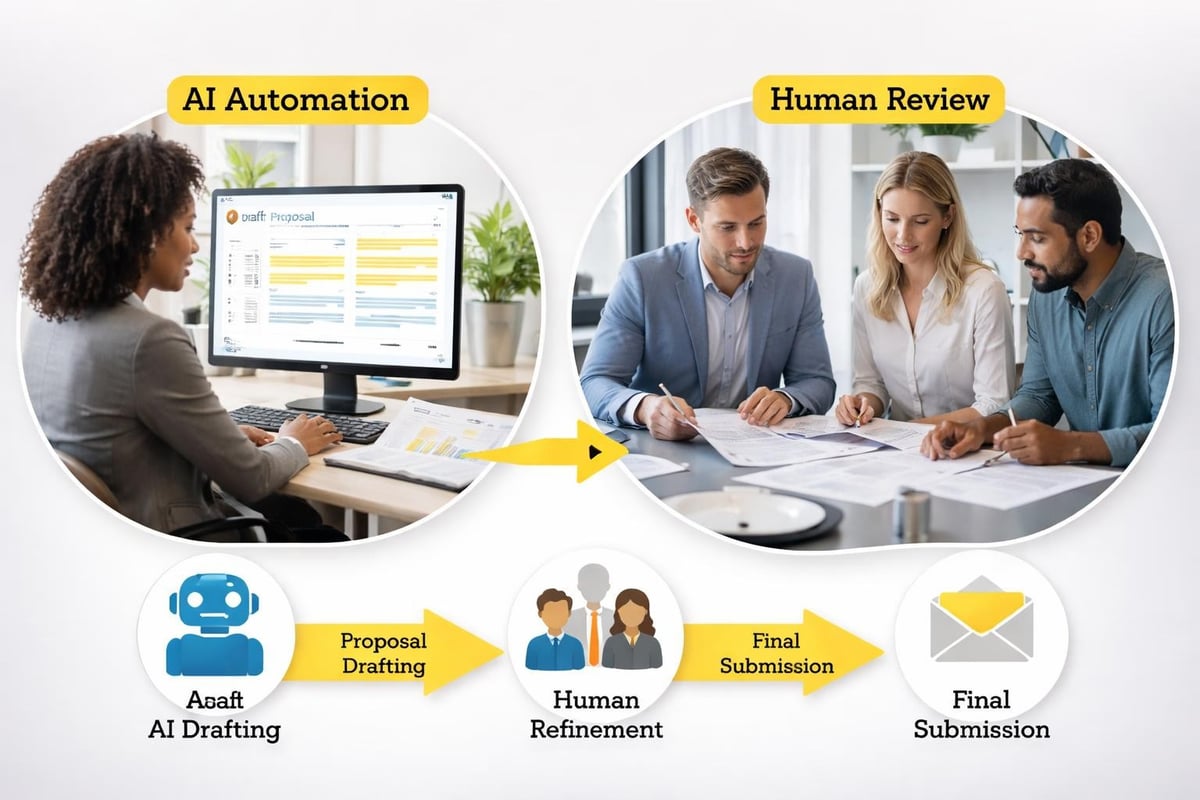
Smart agencies use AI for efficiency while maintaining human oversight for compliance. Understanding Upwork's automation policies prevents account issues.
When Each Approach Wins: Scenario Analysis
AI Agent Victory Scenarios
An upwork ai agent dominates in these situations:
- High-volume, lower-value projects ($500-$5,000 range)
- Fast-turnaround opportunities requiring immediate responses
- Standard service offerings with proven templates
- Competitive categories where speed determines visibility
- Time-zone disadvantages requiring 24/7 coverage
Agencies report 50+ weekly proposals per team member without proportional staff expansion when implementing AI systems — compared to 8-12 proposals manually.
Manual Approach Victory Scenarios
Human bidders win when:
- Enterprise contracts with six-figure potential
- Complex requirements needing custom solution design
- Relationship-focused clients prioritizing communication
- Specialized industries requiring deep expertise demonstration
- Ambiguous projects where clarification questions add value
A manual proposal for a $75,000 project might take 3 hours but convert at significantly higher rates than AI-generated proposals on similar high-value work, where personalization and strategic positioning make the difference.
The Hybrid Approach: Best of Both Worlds
AI for Scale, Humans for Strategy
The winning formula for 2026 combines AI speed with human judgment. The best agencies automate the repetitive 85% of proposal work — job matching, requirement analysis, portfolio selection, and initial drafting — while humans focus on strategy and personalization.
The hybrid workflow:
- AI monitors job feeds 24/7 and scores matches — tools like Vibe Scan rate every job 0-10 based on agency fit
- AI generates proposal drafts using [[double bracket]] instructions that encode agency expertise into reusable templates
- Humans review, personalize, and add strategic elements for high-value opportunities
- Auto Reply sends the first response within minutes when a client replies — keeping leads warm even when the team is offline
- Humans manage deeper client communication and follow-up
This approach maintains sub-10-minute response times while preserving the personalization that converts high-value clients.
Real Agency Results
| Metric | Pure Manual | Pure AI | Hybrid Approach |
|---|---|---|---|
| Weekly proposals per member | 8-12 | 50+ | 50+ with review |
| Win rate | 15-25% | 3-5% | 8-30% |
| Hours per week on proposals | 30-35 | 2-3 | 5-8 |
| Personalization level | High | Low | Medium-High |
| Response time | 4-6 hours | 5-10 min | 5-10 min |
The hybrid model matches AI speed while maintaining win rates significantly above the industry average of 3-5%.
Making Your Choice: Strategic Framework
Evaluate Your Agency Position
Choose your approach based on these factors:
Go AI-heavy if you:
- Focus on volume over individual contract size
- Offer standardized services with proven templates
- Compete in fast-moving, price-sensitive categories
- Need to maximize proposal quantity with limited staff
- Target contracts under $5,000
Go manual-focused if you:
- Specialize in enterprise or complex projects
- Differentiate through unique problem-solving
- Build long-term client relationships
- Target contracts over $20,000
- Operate in regulated industries
Choose hybrid if you:
- Want maximum market coverage
- Serve diverse client segments
- Balance efficiency with quality
- Need competitive advantage across price points
- Value team capacity optimization
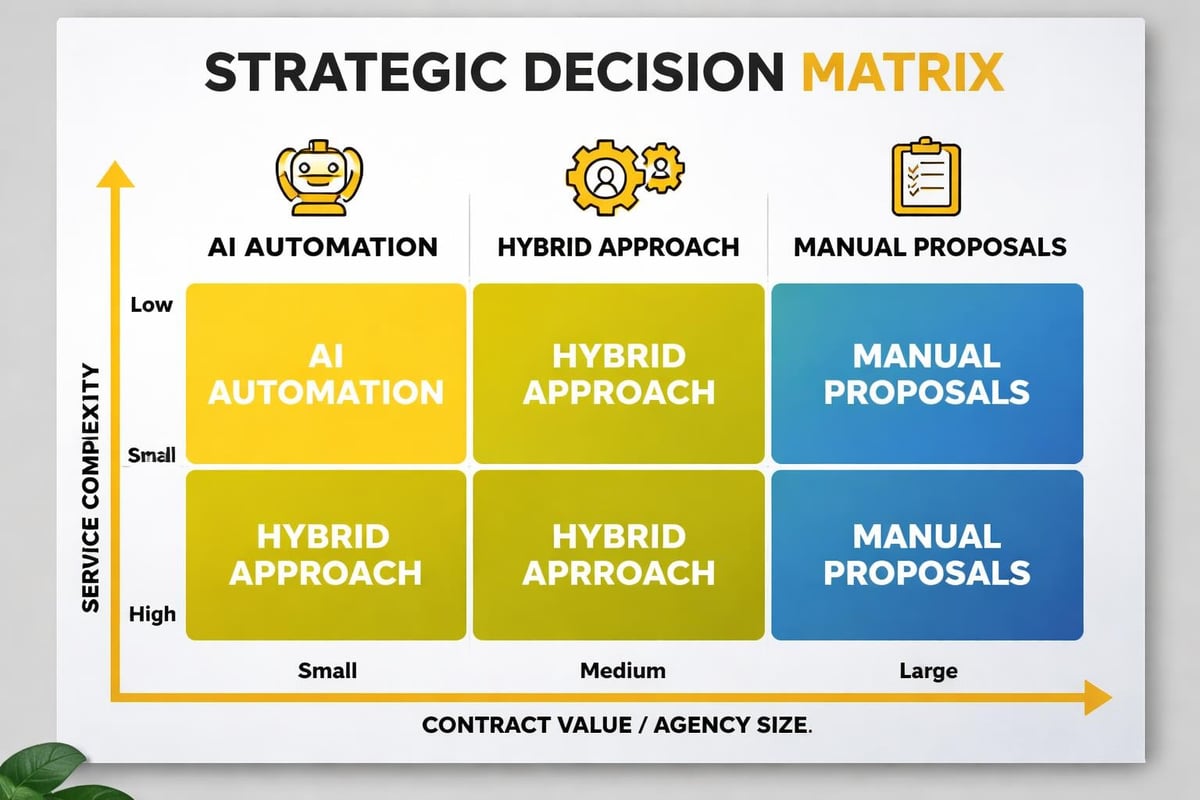
Data-Driven Insights from 300+ Agencies
Agencies using automation tools since 2023 report consistent patterns. Pure AI approaches maximize proposal volume but plateau at 3-5% win rates. Pure manual approaches achieve 15-25% win rates but can't scale beyond 8-12 daily proposals per team member.
The winning metrics come from hybrid systems:
- 8-30% win rates (near-manual quality at AI scale)
- 50+ weekly proposals per team member
- 5-10 minutes per proposal instead of 30-60
- 5-8 hours weekly time investment (saving 30 hours)
- Sub-10-minute response times even offline
These results explain why hybrid automation now powers successful agencies across development, design, marketing, and consulting categories.
Implementation Considerations for 2026
Technical Setup Requirements
Implementing an upwork ai agent requires:
- Job monitoring systems for real-time opportunity detection and scoring
- Proposal template libraries with dynamic personalization logic
- Quality control workflows ensuring human review touchpoints
- Compliance protocols maintaining Upwork terms alignment
- Performance tracking measuring win rates and conversions
Modern platforms handle these requirements through integrated systems, reducing setup complexity from weeks to hours.
Team Training and Workflow Adjustment
Shifting to AI-assisted proposal creation changes team dynamics. Bidders transition from writing every proposal to reviewing, personalizing, and optimizing AI outputs. This requires:
- Training on AI tool capabilities and limitations
- Establishing review standards and quality thresholds
- Creating escalation protocols for complex opportunities
- Defining personalization guidelines for different contract values
- Monitoring metrics to optimize the automation-human balance
Agencies typically need 2-4 weeks to establish efficient hybrid workflows.
AI or Manual? The Smart Answer Is Both
The choice between an upwork ai agent and manual proposals isn't binary. The agencies winning in 2026 recognize that both approaches offer value in different contexts. Speed and volume matter for market coverage. Personalization and strategy matter for conversion quality.
Smart implementation combines AI efficiency for standard opportunities with human expertise for high-value projects. This hybrid approach delivers 50+ proposals weekly per team member while maintaining 8-30% win rates — compared to the 3-5% industry average.
GetMany helps Upwork agencies implement this balanced approach. The platform's Cover Letter Builder uses [[double bracket]] instructions to generate personalized proposals in 5-10 minutes, while Vibe Scan eliminates 80% of irrelevant jobs before you see them. Trusted by 300+ agencies since 2023, saving 30 hours weekly per team. Start automating your proposals → | See a demo →