21 April, 2026

Category
upwork-ai-automation-guide
Author
Getmany
Upwork AI Automation: Complete Guide for Agencies in 2026
The freelance marketplace landscape has fundamentally transformed over the past three years, with artificial intelligence reshaping how agencies operate on platforms like Upwork. As we navigate 2026, upwork ai automation has evolved from a competitive advantage into an operational necessity for agencies seeking sustainable growth. The integration of intelligent systems now handles everything from lead discovery to proposal generation, allowing agencies to focus on strategic relationships and quality service delivery rather than repetitive administrative tasks.
Upwork ai automation addresses these challenges through intelligent systems that analyze job postings, match opportunities to agency capabilities, and generate tailored proposals at scale. Platforms like GetMany demonstrate how comprehensive automation works in practice — automating 85% of Upwork workflows from job discovery to proposal generation to analytics, saving agencies 30 hours weekly on average.
The Technology Behind Modern Automation
Today's automation platforms leverage several core technologies working in concert:
- Natural Language Processing (NLP) for analyzing job descriptions and extracting key requirements
- Machine Learning algorithms that improve proposal quality based on historical success rates
- Smart filtering engines that eliminate irrelevant opportunities before human review
- Data integration systems connecting Upwork with CRM and project management tools
- Predictive analytics identifying high-probability opportunities before competitors
Research frameworks like UpBench provide standardized benchmarks for evaluating how well AI agents perform in real-world freelance marketplace scenarios. These evaluations help agencies understand which automation capabilities deliver measurable returns versus which remain experimental.

Key Benefits Driving Agency Adoption
The value proposition of upwork ai automation extends far beyond simple time savings. Agencies report multifaceted improvements across their operations when implementing comprehensive automation strategies.
Time Efficiency and Resource Allocation
The most immediate benefit manifests in time reclamation. Manual proposal writing typically takes 30–60 minutes per proposal. With AI-powered automation, that drops to 5–10 minutes while improving quality and personalization. Agencies that previously submitted 5–10 proposals weekly can now send 50+ without burnout — a shift documented in head-to-head comparisons of AI agent vs manual approaches.
| Metric | Manual Approach | With AI Automation |
|---|---|---|
| Time per proposal | 30–60 minutes | 5–10 minutes |
| Proposals per week | 5–10 | 50+ |
| Proposal win rate | 3–5% (industry avg) | 8–30% |
| Response rate | Baseline | 2.5x higher |
| Admin hours per week | 30+ | Under 5 |
Quality Improvements Through Consistency
Contrary to concerns about automation reducing personalization, modern upwork ai automation systems actually enhance proposal quality. AI-powered platforms maintain consistent brand voice across all communications while customizing content to specific job requirements. They detect subtle signals in job descriptions that human reviewers might overlook, ensuring proposals address unstated client concerns. The challenge of personalizing proposals at scale is where AI-driven systems create the largest competitive gap.
Competitive Positioning and Response Speed
The Upwork marketplace operates on rapid response timelines, with many clients reviewing proposals within hours of posting. Manual processes cannot compete with automated systems that identify relevant jobs within minutes and submit customized proposals within the hour. Speed-to-market becomes particularly crucial for agencies competing in high-demand categories.
Essential Features of Effective Automation Systems
Not all automation platforms deliver equivalent value. Agencies evaluating solutions should prioritize specific capabilities that align with their operational models and growth objectives.
Intelligent Job Matching and Filtering
GetMany's Vibe Scan goes beyond keyword matching by scoring each job opportunity 0–10 based on fit with your agency profile and past performance. It automatically eliminates 80% of irrelevant opportunities so your team focuses exclusively on work worth winning. Set preferences in plain English — "React Native for US startups, $40/hour+" — and the system adjusts scoring in real time based on your profile and past results.
Dynamic Proposal Generation
Modern proposal automation extends far beyond mail-merge templates. GetMany's Cover Letter Builder uses a unique [[double bracket]] instruction system to achieve personalization at scale. Write a proposal template once with [[double bracket]] placeholders — for example, [[reference a relevant portfolio project]] or [[mention the client's stated timeline]] — and the AI fills in each one with content specific to that job.
The result: genuinely personalized proposals in 5–10 minutes instead of 30–60, with win rates of 8–30% versus the 3–5% industry average. Agencies run 50+ proposals weekly without burning out their team. Pre-built templates (All-Purpose, Case Study Focused) are available across multiple AI models including Claude 4 and GPT-4.1.
Integration Capabilities and CRM Connectivity
Comprehensive upwork ai automation platforms integrate with existing agency infrastructure across every stage of the workflow:
- CRM systems for automatic lead capture and opportunity tracking
- Project management tools enabling seamless client onboarding when proposals convert
- Analytics dashboards measuring proposal performance, win rates, and ROI metrics
- Team collaboration tools for reviews and approvals within existing workflows
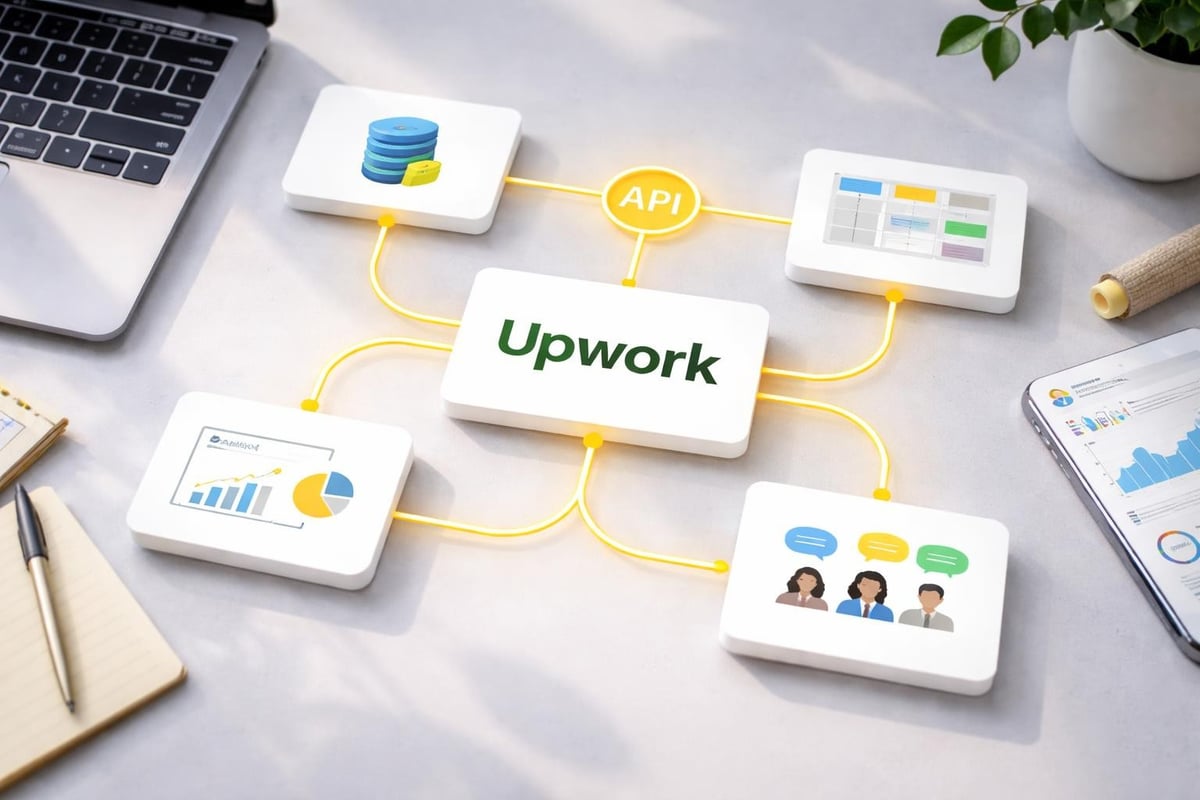
For agencies that run their pipeline in spreadsheets or CRMs, GetMany's Google Sheets Integration syncs job listings, deals, and proposals in real time — no manual exports, no data entry lag. This makes managing Upwork leads like a CRM a practical reality rather than a workaround.
For agencies managing multiple client conversations simultaneously, GetMany's Master Inbox provides a unified view of all Upwork chats with Kanban-style organization. Instead of switching between Upwork tabs and losing context, your team handles all client communication, task assignment, and deal tracking from one place — without leaving GetMany.
Implementation Strategies for Maximum Impact
Successful automation adoption requires strategic planning. Agencies that achieve the highest returns follow structured implementation pathways.
Phase One: Assessment and Foundation
Begin by documenting current processes in detail. Map every step from job discovery through proposal submission, identifying bottlenecks, repetitive tasks, and quality control points. Audit existing tools and subscriptions to eliminate redundancy. Many agencies discover they're paying for multiple platforms offering overlapping capabilities when integrated solutions would serve them better.
Phase Two: Pilot Testing and Refinement
Identify a specific workflow segment for initial implementation. Proposal generation represents the ideal starting point for most agencies due to its time intensity and measurable outcomes. Run parallel processes during pilot phases, tracking response rates, conversion percentages, time per proposal, and client feedback.
Phase Three: Scaling and Optimization
After validating effectiveness in pilot scenarios, expand automation to additional workflow components. Establish feedback loops where proposal performance data continuously refines automation parameters. Monitor which customization elements correlate with success, adjusting templates and AI prompts accordingly.
Balancing Automation with Human Expertise
The most sophisticated agencies recognize that upwork ai automation enhances rather than replaces human judgment. Strategic oversight remains essential for maintaining quality, building relationships, and navigating complex client situations.
Where Humans Add Irreplaceable Value
- Strategic Decision-Making: Determining which opportunities align with long-term business objectives
- Relationship Building: Developing trust and rapport with high-value clients through authentic communication
- Complex Problem-Solving: Addressing unique client challenges requiring creative solutions
- Quality Assurance: Reviewing AI-generated content for accuracy and brand alignment
- Learning and Adaptation: Identifying market shifts that require strategy adjustments
Research on hybrid AI-human platforms like Tendem demonstrates how combining automation with human expertise delivers superior outcomes compared to either approach in isolation.
One practical example: automated first responses keep leads warm even when your team is offline. GetMany's Auto Reply sends a customized message the moment a client replies to your proposal — qualifying leads and maintaining engagement without requiring anyone to be online. This bridges automation and relationship-building at a critical moment in the sales process.
Establishing Review Protocols
Implement tiered review processes based on opportunity value and complexity:
| Proposal Value | Automation Level | Human Review |
|---|---|---|
| Under $500 | 95% automated | Spot check (10% sample) |
| $500–$2,000 | 85% automated | Quick review (every proposal) |
| $2,000–$10,000 | 70% automated | Detailed review + customization |
| Over $10,000 | 50% automated | Comprehensive human involvement |

Measuring ROI and Performance Metrics
Quantifying automation value ensures continued investment and identifies optimization opportunities. Agencies should track both efficiency metrics and outcome-based indicators.
Efficiency Metrics to Monitor
- Proposals submitted per week (pre and post-automation comparison)
- Average time per proposal from job discovery to submission
- Team hours allocated to proposal development versus other activities
- Cost per proposal including tool subscriptions and labor
- Proposal volume handled per team member
Outcome Metrics That Matter
- Proposal-to-interview conversion rate
- Interview-to-contract win rate
- Average contract value from automated versus manual proposals
- Client satisfaction scores in initial interactions
- Long-term client retention from automation-sourced relationships
- Revenue per agency team member
GetMany's Analytics Dashboard tracks these metrics automatically — proposal performance, win rates by template, client engagement timelines, and CSV export for deeper analysis. Data from 10,000+ proposal submissions shows that agencies who actively A/B test their templates improve win rates by 40–60% within three months.
Common Pitfalls and How to Avoid Them
Over-Automation Without Strategic Focus
Automating everything simultaneously often backfires. Agencies spreading implementation efforts too thin experience inadequate tool configuration, team resistance from insufficient training, quality issues from rushed deployment, and difficulty isolating which changes drive results. Prioritize automation of high-volume, low-complexity tasks first.
Neglecting Personalization and Brand Voice
Generic, obviously automated proposals damage agency reputation. Clients immediately recognize templated content lacking genuine understanding of their specific needs. The [[double bracket]] instruction system solves this directly — maintaining full control over voice and structure while the AI handles per-job personalization at scale.
Ignoring Data Security and Compliance
Automation platforms access sensitive client information and business intelligence. Evaluate providers' security practices, data handling policies, and compliance certifications. Ensure contracts address intellectual property rights and confidentiality obligations.
Failing to Update and Maintain Systems
Market conditions, platform policies, and client expectations evolve constantly. Static configurations become less effective over time. Schedule quarterly reviews of automation performance, updating templates, filters, and algorithms based on current results.
Advanced Strategies for Competitive Advantage
Results From Agencies Already Using Automation
The best evidence for upwork ai automation comes from agencies already running these systems at scale. Five agencies that 10x'd their proposals share a common pattern: they started with Cover Letter Builder automation, measured results using the Analytics Dashboard, then gradually expanded to full workflow automation over 60–90 days. Results ranged from doubling win rates to tripling monthly revenue without adding headcount.
Multi-Platform Integration and Cross-Channel Presence
Top-performing agencies extend automation approaches across multiple freelance marketplaces, job boards, and lead sources. Integrated systems aggregate opportunities from diverse channels, applying consistent evaluation criteria regardless of source platform. This diversification reduces platform dependency while multiplying opportunity volume without proportional resource increases.
Predictive Opportunity Scoring
Machine learning models trained on historical win/loss data predict conversion probability before significant effort is invested. These systems analyze client posting history, budget alignment, project scope clarity, competitive landscape, and timing signals. Agencies focusing on high-probability opportunities consistently outperform competitors pursuing every visible posting.
Future Directions in Freelance Marketplace Automation
The upwork ai automation landscape continues evolving rapidly. Several emerging trends promise to reshape agency operations over the next 12–24 months:
- Conversational AI handling initial client communications, clarifying requirements, and negotiating basic contract terms
- Autonomous project management linking marketplace automation directly to project delivery platforms
- Collaborative AI agents coordinating across team members, automatically delegating tasks and managing workflows
- Enhanced quality assurance systems reviewing proposals and deliverables before they reach clients
Building a Sustainable Automation-First Agency Model
Agencies successfully implementing upwork ai automation share common characteristics: technical fluency across teams, specialized roles centered on automation, and continuous feedback loops that make their systems more effective over time.
The shift isn't just operational — it's cultural. Teams that treat automation as a learning system, not a static tool, consistently stay ahead. They analyze which proposal variations convert best, identify new opportunity categories, refine quality standards based on client feedback, and update AI training data with each successful engagement.
Conclusion
Upwork AI automation has moved from an experiment to a competitive requirement. GetMany's AI Agency Manager gives agencies the complete workflow: Vibe Scan eliminates 80% of irrelevant jobs instantly, the Cover Letter Builder generates personalized proposals using [[double bracket]] instructions in 5–10 minutes (versus 30–60 manual), Auto Reply keeps leads warm around the clock, and Master Inbox centralizes all client communication in one place. More than 300 agencies worldwide have made the shift, saving 30 hours weekly while achieving win rates of 8–30%.
Start automating your Upwork proposals →
Or book a demo to see exactly how GetMany fits your agency's workflow.