Last updated:
GetMany vs. GigRadar: Which Upwork AI Bidder Wins for Agencies in 2026?
GetMany is an Upwork AI automation platform built for digital agencies. GigRadar is an AI lead-generation tool for both freelancers and agencies, operating through their own Upwork Business Manager account. This comparison breaks down where each one wins, where each one falls short, and which agencies should pick which.

What is GigRadar?
GigRadar is an Upwork AI bidder founded in 2020. The product positions itself as an "AI Agent for Upwork that Generates Leads for Agencies." It automates job discovery, generates personalized cover letters, and submits proposals at scale.
The most distinctive thing about GigRadar is architectural. The vendor operates its own real Upwork Business Manager account. Each agency invites the GigRadar BM into their workspace through Upwork's official invitation system. Proposals submit from GigRadar's BM, not from the agency's own account. This is unusual in the Upwork automation space and shapes most of the rest of the product.
GigRadar holds 4.7 out of 5 on Trustpilot from 183 reviews and has a strong content marketing engine, with 472 organic keywords ranked across the US Google index as of April 2026.
What is GetMany?
GetMany is an Upwork AI automation platform built specifically for digital agencies. It was founded in 2023 by Kyrylo Kozak and Vitaliy Drozhdin and is registered as Getmany Software LLC in Sheridan, Wyoming.
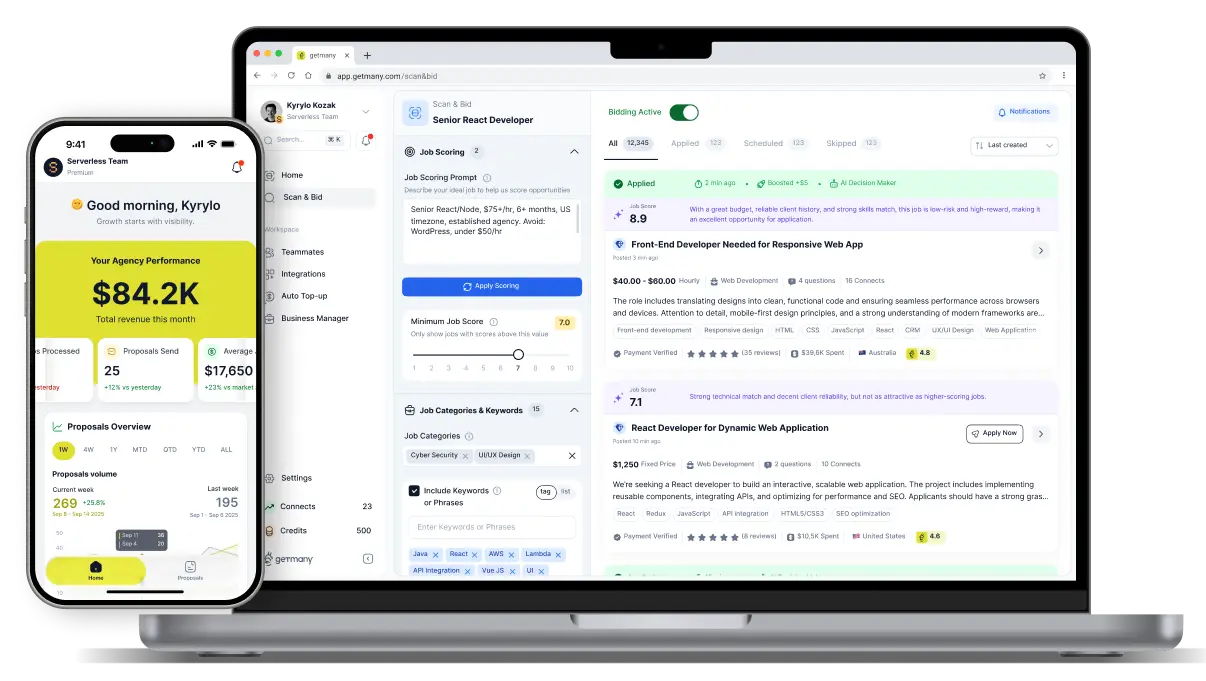
The product runs three connected layers. A Job Search Engine filters incoming Upwork posts by skill stack, hourly or fixed budget, client country, and contract length. Multi-model AI proposal generation drafts a personalized cover letter for each shortlisted job and lets the agency pick which LLM writes each submission. Smart Delay and Smart Limits pace deliveries inside human-realistic windows so each Upwork agency stays within Upwork's expected human-pace ranges.
As of 2025, GetMany serves more than 150 agency customers including Kyivstar.Tech, has facilitated more than 6 million USD in client revenue, and reports approximately 43,000 USD in monthly recurring revenue. Vizio AI, an early agency customer, generated over 100,000 USD on Upwork using the platform.
Quick comparison
GetMany is the better choice for digital agencies running multi-seat Upwork operations that want full ownership of their bidding channel, multi-model AI proposal generation, and a pilot before commitment. GigRadar is the better choice for agencies that want vendor-managed account safety, prefer a single proven proposal model, and have budget for a paid commitment without testing first.
| Feature | Getmany | GigRadar |
|---|---|---|
| Built for | Digital agencies | Freelancers and agencies |
| AI proposal models | 8 model variants (Claude, GPT) | Single model |
| Account submission origin | Your own Upwork account | GigRadar's Business Manager |
| Account safety controls | Smart Delay + Smart Limits + AI Decision Maker | Internal pacing |
| Hire-probability scoring | AI Decision Maker (1 to 10) | Not documented |
| MCP for Upwork support | Yes, public server | No |
| Multi-seat agency workflows | Yes, per-bidder controls | Limited |
| Free trial | No | No |
| Public pricing | Yes | No, demo-gated |
| Starting price | Credit-based, transparent | $208 to $470 per month |
| Cover letter time | 60 seconds | Within 15 minutes |
| Auto Reply (first message) | Yes | No |
| Founded | 2023 | 2020 |
| Notable customers | Kyivstar.Tech, Vizio AI | Public list not disclosed |
Feature-by-feature comparison
Proposal generation: multi-model AI vs single LLM
GetMany ships eight different AI model variants, including Claude and OpenAI options. Each agency configures which model writes each submission, so output style adjusts per market segment. A web-development agency bidding to enterprise clients can use a different model than the same agency bidding to startup founders.
GigRadar uses a single proposal model. Their stated approach uses both the freelancer's profile and the client's job description to extract pain points, expectations, and questions that showcase expertise. The output quality is reportedly strong. After their team analyzed over one million proposals, they concluded that AI-generated cover letters get higher reply rates than human-written ones.
Verdict:
GetMany wins for agencies serving multiple client tiers. GigRadar's single-model approach is simpler to operate but less flexible.
Account safety: who absorbs the risk
This is the most consequential architectural difference between the two products.
GigRadar's model is vendor-managed. Their own Upwork BM submits all proposals. The agency joins their BM. If GigRadar's pacing and content quality are good, the BM stays in good standing. Risk lives with the vendor.
GetMany's model is agency-owned. Submissions go from the agency's own Upwork account, with Smart Delay (1 to 60 minute configurable windows), Smart Limits (per-bidder daily and weekly caps), and AI Decision Maker (skip low-probability jobs before connects spend) handling pacing and quality. Risk lives with the agency, but visibility, control, and ownership of the channel also live with the agency.
Why this matters: if GigRadar's BM ever runs into a Upwork policy issue, every customer on their BM is affected at once. With GetMany, one agency's mistake stays inside that agency's account. Agencies that have invested in their own Upwork reputation and want to keep it under their direct control prefer the GetMany model.
Verdict:
Different trade-offs, but GetMany gives agencies more transparency and direct control.
AI Decision Maker (hire-probability scoring)
GetMany ships a feature called AI Decision Maker. Before a connect is spent, the system scores the opportunity from 1 to 10 against the agency's custom instruction set, with automatic apply or skip logic. This shifts the agency from "send as many proposals as possible" to "send only proposals likely to convert."
A practical example: an agency with five bidders sends roughly 350 proposals per week if each bidder maxes out connects. AI Decision Maker scoring at a threshold of 7 reduces that to 175 to 225 proposals, but reply rates and hire rates rise because the remaining proposals are higher-fit. Agencies in our research see roughly 40 percent connect savings within the first 30 days.
GigRadar does not document an equivalent feature in their public materials. They emphasize bid quality through their cover-letter approach but do not appear to score opportunities pre-submission.
Verdict:
GetMany clear winner. AI Decision Maker is a documented agency-tier feature with measurable connect savings.
MCP for Upwork integration
GetMany ships a public MCP for Upwork server. Any AI client that speaks Model Context Protocol, including Claude Desktop and Cursor, can drive Upwork proposal generation, submission scheduling, and pipeline management programmatically. This matters for AI-first agencies and for teams building custom internal AI workflows.
GigRadar does not currently offer an MCP server or Model Context Protocol integration as of April 2026.
Verdict:
GetMany clear winner. If your team uses Claude Desktop, Cursor, or any other MCP-compatible client, this is a significant differentiator.
Multi-seat agency workflows
GetMany was built for digital agencies from day one. Multi-seat workflows, team-shared proposal libraries, role-based access, and per-bidder Smart Limits ship with the product. An agency with 10 bidders can configure each seat with its own pacing, its own model preferences, and its own daily caps, while still drawing from a shared template library.
GigRadar serves both freelancers and agencies. Their multi-seat features are limited. The Business Manager model centralizes team activity inside the GigRadar BM, which works for some agencies but does not give per-bidder configurability.
Verdict:
GetMany wins for agencies running 3 or more bidders.
Pricing model
GigRadar pricing is demo-gated. There is no public pricing page. Multiple third-party sources report quarterly plans at approximately 450 to 470 USD per month and an annual promo bringing the effective rate to around 208 USD per month (about 2,500 USD per year). There is no free pilot. Agencies must commit financially before testing the platform.
GetMany pricing is publicly visible at getmany.com/pricing. The product uses a credit-based subscription where credits consume only when a proposal is actually submitted, so spend correlates with actual activity rather than a fixed seat count.
Verdict:
GetMany clear winner on transparency and on cost-control architecture.


When GigRadar is the better choice
Honest disclosure: GigRadar is a real product with real strengths, and there are scenarios where it fits better than Getmany.
GigRadar wins for agencies that prefer fully vendor-managed account safety. If your team does not want to operate Smart Delay configurations, Smart Limits per bidder, or AI Decision Maker scoring rules, GigRadar's BM model removes those decisions from your plate. You join their BM, they handle the technical pacing, and you focus on closing.
GigRadar also wins for agencies that value an established 4.7-star Trustpilot record over newer products. GigRadar has been operating since 2020 and has 183 published Trustpilot reviews. GetMany was founded in 2023 and has fewer public reviews even though customer count is comparable.
GigRadar's content marketing depth is also a distinct asset. Their blog ranks for hundreds of Upwork-adjacent keywords and provides agency-tier educational material that some teams use independently of the product itself. If your team values that ambient resource, you may prefer to keep using their tool stack.
Finally, agencies that only need a single AI model and do not want to manage configuration choices may find GigRadar's single-LLM approach simpler.
When GetMany is the better choice
GetMany is the better choice for digital agencies in five concrete situations.
You want to own your Upwork channel. Submissions from your own Upwork BM mean reputation, history, and risk all stay under your direct control. You audit your own activity. You decide your own pacing. You do not depend on a vendor-managed account staying healthy.
You run more than two bidders. Per-bidder Smart Limits, role-based access, and team-shared proposal libraries handle multi-seat operations natively. AI Decision Maker scoring applies independently per seat.
You serve multiple client tiers. Configurable multi-model AI lets you choose Claude for nuanced cover letters to enterprise clients and OpenAI for higher-throughput startup work, all from the same platform.
You want results, not just access. GetMany offers a 3-month pilot subscription with no long-term commitment. Because it's paid, your team is actually invested in making it work - free tools get ignored, paid pilots get results.
You build custom AI workflows. The public MCP for Upwork server lets Claude Desktop, Cursor, and any MCP-compatible client drive your bidding programmatically.
Migrating GigRadar → GetMany
For agencies considering a switch, the transition takes about a week of overlapping operation.
Most agencies complete the switch in 7 to 10 days. Vizio AI, a published GetMany customer, reached 100,000 USD in Upwork revenue inside their first quarter on the platform. For background on what makes Upwork bidding different from other freelance platforms, see the Upwork vs freelance platforms 2026 comparison.

Step 1
Export your existing skill filters, cover-letter templates, and client preferences from GigRadar. Most agencies have these documented in their internal Notion or Google Docs already.
Step 2
Recreate skill filters in GetMany's Job Search Engine. Six filters cover skill stack, budget, client country, contract length, hire rate, and posted-time. Map your GigRadar filters one-to-one.
Step 3
Upload your past winning proposals to GetMany's template library. The multi-model selector uses these as in-context examples for new proposals.
Step 4
Set per-bidder Smart Limits below your current GigRadar pace for the first seven days. This gives Upwork's behavioral model time to adjust to the new submission origin (your own account vs. the previous BM).
Step 5
Run AI Decision Maker at threshold 6 for the first two weeks, then tune up to 7 once your team is comfortable with the scoring. Aggressive thresholds save more connects but reduce volume.
GetMany has truly transformed our lead generation process, making it more efficient and scalable.
$100k+
Revenue Generated with GetMany
40x
ROI ($1 Spent on GetMany = $40 Revenue)
17k+
Proposals Sent Through GetMany

Frequently Asked Questions
The information you need to make the most of our platform.
Not sure if GetMany fits your workflow?
Book a free 1-on-1 consultation with our team. We'll walk you through the platform and show you exactly how multi-model AI, AI Decision Maker scoring, and agency-tier workflows can work for your Upwork account.