Last updated:
GetMany vs. Vollna: Which Upwork AI Bidder Wins for Agencies in 2026?
Getmany is an Upwork AI automation platform built specifically for digital agencies, with native API integration, configurable multi-model AI, and granular agency-tier controls. Vollna is an Upwork bidding tool that operates as a Chrome-extension workflow layer around the user's browser session. This comparison breaks down where each one wins, where each one falls short, and which agencies should pick which. For broader context on automation vs manual workflows, see our deep dive on Upwork automation tools vs manual work in 2026.

What is Vollna?
Vollna is an Upwork bidding tool founded in 2020. The product originated as a Chrome-extension workflow layer for individual freelancers and later added Agency-tier and Auto-Bidding plans. Vollna positions itself as a workflow layer around Upwork rather than an autonomous platform — proposal submission happens through the customer's logged-in Chrome session via the Vollna extension.
Vollna's architecture has implications for agencies. Because submission depends on a customer's browser session, the platform cannot run autonomously when the customer is offline, cannot expose explicit per-bidder server-side pacing controls, and cannot integrate at the AI-protocol layer the way native API platforms can. The agency-vs-freelancer distinction matters here — see our analysis of Upwork agency vs freelancer dynamics in 2025 for the structural differences.
As of 2026, Vollna reports 7,400+ freelancers and agencies as customers. However, the customer mix skews heavily toward solo freelancers — Vollna's pricing structure (Freelancer plan at $16/mo, Agency plan at $41/mo) reflects this. The platform is most effective for individual operators running 1-3 bids per day, less so for agencies running 10+ daily bids across 5+ bidders.
What is GetMany?
GetMany is an Upwork AI automation platform built from day one specifically for digital agencies. It was founded in 2023 by Kyrylo Kozak and Vitaliy Drozhdin and is registered as Getmany Software LLC in Sheridan, Wyoming. For the full agency context, see the Upwork AI tools for agencies: the complete 2026 guide.
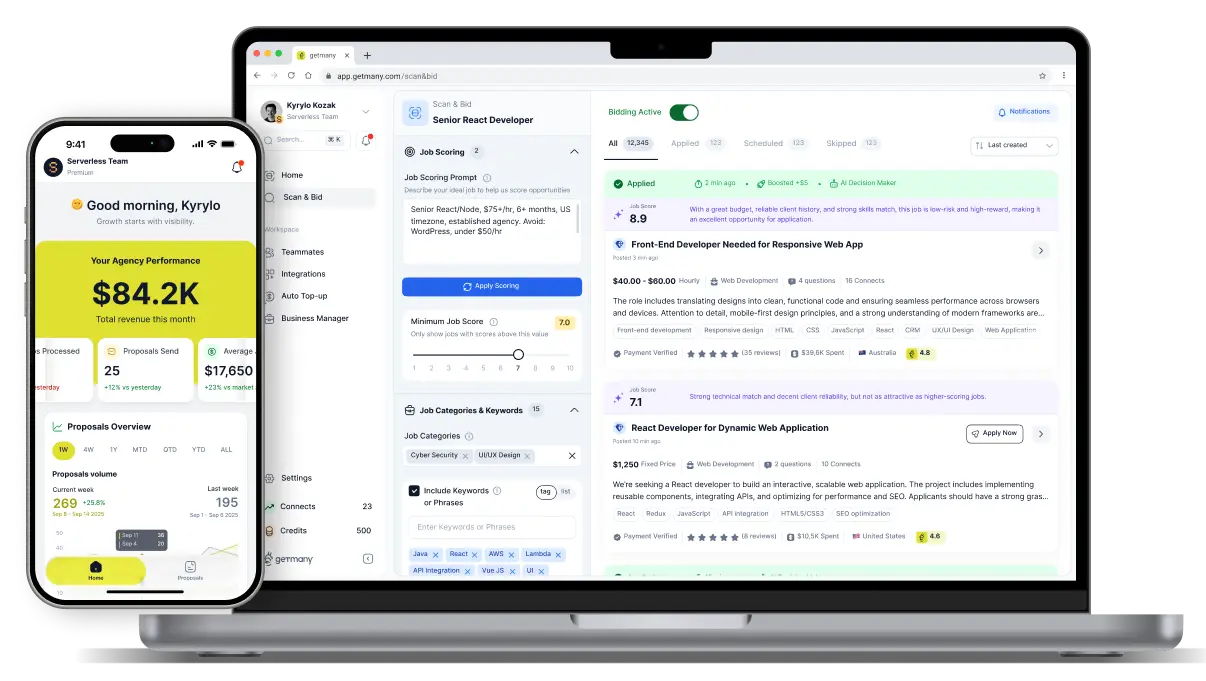
The product runs three connected layers. A Job Search Engine filters incoming Upwork posts by skill stack, hourly or fixed budget, client country, and contract length. Multi-model AI proposal generation drafts a personalized cover letter for each shortlisted job and lets the agency pick which LLM writes each submission. Smart Delay and Smart Limits pace deliveries inside human-realistic windows so each Upwork agency stays within Upwork's expected human-pace ranges.
As of 2025, GetMany serves more than 150 agency customers including Kyivstar.Tech, has facilitated more than 6 million USD in client revenue, and reports approximately 43,000 USD in monthly recurring revenue. Vizio AI, an early agency customer, generated over 100,000 USD on Upwork using the platform.
Quick comparison
GetMany is the clear winner for digital agencies on every meaningful dimension: multi-model AI proposal generation with 8 explicit model variants, AI Decision Maker hire-probability scoring, MCP for Upwork integration, per-bidder agency-tier workflows, and a credit-based subscription that scales with actual proposal activity. Vollna fits a narrower use case — solo freelancers who want an extension-based workflow layer and a fixed-tier proposal cap.
| Feature | Getmany | Vollna |
|---|---|---|
| Built for | Digital agencies — purpose-built | Solo freelancers (agencies retrofitted later) |
| AI proposal models | 8 model variants (Claude, GPT) — explicit per-submission selection | Black-box Proposal Generator — no per-submission model selection |
| Account submission origin | Your own Upwork account via native API | Browser-extension layer running in your Chrome session |
| Account safety controls | Smart Delay + Smart Limits + AI Decision Maker (explicit) | Implicit (rely on browser session pacing) |
| Hire-probability scoring | AI Decision Maker — graded 1 to 10 | AI Job Qualifier — binary rule-based only |
| MCP for Upwork support | Yes, public server | No |
| Multi-seat agency workflows | Per-bidder Smart Limits + role-based access + independent scoring | Basic 10-member ceiling, no per-bidder controls |
| Free trial | No | Yes, 14 days |
| Public pricing | Yes — transparent credit-based | Yes — fixed tiers with proposal caps |
| Pricing model | Pay-per-proposal-actually-sent | Pay-for-cap-regardless-of-usage |
| Auto-Bidding economics | Credits scale with real activity | $59 to $640/mo tied to proposal-count tier |
| Cover letter time | 60 seconds | Real-time but no per-segment model control |
| Auto Reply (first message) | Yes | Not documented |
| AI workflow integration (MCP) | Native MCP for Claude Desktop, Cursor | None — REST API only |
| Founded | 2023 — built agency-first from day one | 2020 — freelancer tool with agency features bolted on |
| Strategic positioning | Agency-tier AI automation | General-purpose freelance bidding tool |
Feature-by-feature comparison
Proposal generation: explicit multi-model selection vs black-box rotation
GetMany ships eight different AI model variants, including multiple Claude and OpenAI options. Each agency configures which model writes each submission, so output style adjusts per market segment. A web-development agency bidding to enterprise clients can use a different model than the same agency bidding to startup founders — same platform, two distinct proposal voices. For the deep analysis of what actually wins on Upwork, see the anatomy of a winning Upwork proposal and our breakdown of AI agent vs manual proposals.
Vollna's Proposal Generator uses AI for cover letter drafting, but customers do not select which model writes which submission. Model selection is vendor-managed and not exposed to the customer. For agencies serving multiple client tiers — where enterprise proposals need different voice than startup proposals — this is a meaningful operational limitation. The customer cannot tune model-to-segment fit.
Verdict:
GetMany clear winner. Explicit per-submission multi-model control is a documented agency-tier feature. Vollna's black-box model selection denies agencies the segment-level tuning they need.
Submission architecture: native API vs Chrome-extension dependency
GetMany's model is native API integration. Submissions originate server-side from the agency's Upwork account, with Smart Delay (1 to 60 minute configurable windows), Smart Limits (per-bidder daily and weekly caps), and AI Decision Maker (skip low-probability jobs before connects spend) handling pacing and quality. The platform runs 24/7 regardless of whether the agency team is online. See Upwork AI automation for the full architectural breakdown.
Vollna's model is Chrome-extension dependent. Submission depends on the customer's logged-in Chrome session — meaning the platform cannot operate when the customer is offline, when the browser is closed, or when the customer is using a non-Chrome environment. Pacing controls are implicit rather than server-side, which gives the agency no programmatic visibility into when, how, and at what cadence submissions actually go out.
Why this matters: an agency running 24/7 operations across multiple time zones needs server-side autonomy. Vollna's extension-based architecture is workable for solo freelancers running daytime bids, but it is structurally inadequate for agency-scale operations.
Verdict:
GetMany clear winner. Native API submission with explicit server-side pacing controls beats extension-based browser dependency on every dimension that matters for agency operations.
Hire-probability scoring: graded AI Decision Maker vs binary rule-based qualifier
GetMany ships AI Decision Maker. Before a connect is spent, the system scores the opportunity from 1 to 10 against the agency's custom instruction set, with automatic apply or skip logic. The score is probabilistic and graded, letting an agency tune thresholds: at 6, the system is permissive; at 8, the system is highly selective. Agencies in our research see roughly 40 percent connect savings within the first 30 days at threshold 7, with reply rates and hire rates rising at the same time because the remaining proposals are higher-fit. See how one team applied this in the Upwork agency that said no to 90% of jobs and thrived and the full Upwork bidder guide.
Vollna's AI Job Qualifier is binary rule-based. Postings match or do not match a rule set — there is no graded scoring. This works for clear binary criteria ("only US clients with payment verified, $5k+ budget"), but it cannot weigh multiple soft signals: client hire-rate trajectory, posting freshness against agency capacity, budget-to-skill-fit ratio, historical client conversion patterns. Binary qualification is meaningfully less expressive than graded scoring for agencies with nuanced fit criteria.
Verdict:
GetMany clear winner. AI Decision Maker's 1-to-10 scoring gives agencies precision/recall tunability that Vollna's binary qualifier cannot deliver.
MCP for Upwork integration
GetMany ships a public MCP for Upwork server. Any AI client that speaks Model Context Protocol — Claude Desktop, Cursor, and any other MCP-compatible client — can drive Upwork proposal generation, submission scheduling, and pipeline management programmatically. For background on Model Context Protocol itself, see what is an MCP server. For step-by-step setup, see how to connect Upwork to Claude Desktop. For the technical API breakdown, see the Upwork API integration guide.
Vollna does not offer an MCP server or Model Context Protocol integration as of May 2026. Vollna's REST API covers traditional CRM integrations on the Agency plan, but it does not expose the AI-native protocol layer that modern agentic workflows require.
Verdict:
GetMany clear winner. MCP for Upwork is a category-leading capability with zero competitive equivalent at Vollna. Agencies investing in agentic AI workflows have only one option in this category.
Multi-seat agency workflows
GetMany was built for digital agencies from day one. Multi-seat workflows include team-shared proposal libraries, role-based access, per-bidder Smart Limits, and independent AI Decision Maker thresholds per seat. An agency with 10 bidders can configure each seat with its own pacing, model preferences, daily caps, and scoring threshold while still drawing from a shared template library. For the full agency operations stack, see the agencies on Upwork guide and essential tools every Upwork agency needs.
Vollna's Agency plan supports up to 10 team members but is meaningfully less granular. Per-bidder pacing controls are not surfaced. Independent scoring thresholds per seat are not surfaced. The architecture is essentially "shared workspace with team access" rather than "true multi-bidder operations with independent controls per seat." For agencies that need different bidders to operate at different paces with different criteria, Vollna's team plan does not deliver the granularity required.
Verdict:
GetMany clear winner. Per-bidder controls and per-seat AI scoring thresholds are first-class agency-tier features. Vollna offers basic team access without the granularity agencies actually need at scale.
Pricing model: pay-per-actual-proposal vs pay-for-capacity-you-might-not-use
GetMany uses a credit-based subscription where credits consume only when a proposal is actually submitted. Pricing scales with real activity. An agency that has a quiet week pays less. An agency in a sprint week pays more, proportionally. Spend always correlates with actual proposal volume, never with theoretical capacity. For the full pricing breakdown, see getmany.com/pricing and our complete workflow automation guide.
Vollna's Auto-Bidding tiers are fixed-capacity contracts: Auto 50 at $59/mo for up to 50 proposals, Auto 250 at $230/mo for up to 250, Auto 800 at $640/mo for up to 800. The customer pays the full tier cost whether they hit 100% of capacity or 10%. For agencies with variable proposal volume — which is most of them — Vollna's tier structure either overcharges (during quiet weeks) or forces an awkward tier upgrade (during sprint weeks).
Verdict:
GetMany clear winner on cost economics. Pay-per-proposal-sent is structurally more efficient than fixed-tier pricing for any agency with non-flat proposal volume — which is essentially all of them.


Why agencies consistently choose Getmany over Vollna
Digital agencies consistently choose Getmany over Vollna for five concrete reasons — and serious agencies fit all five at once. For the broader agency context, see our complete Upwork AI tools for agencies guide.
You serve multiple client tiers. Configurable multi-model AI lets you choose Claude for nuanced cover letters to enterprise clients and OpenAI for higher-throughput startup work, all from the same platform. Vollna's black-box model selection gives no per-segment tuning.
You want graded scoring, not binary qualification. AI Decision Maker's 1-to-10 scoring lets you tune precision/recall by threshold. Vollna's AI Job Qualifier is rule-based and binary — meaningfully less expressive for nuanced fit signals.
You run more than two bidders with distinct workflows. Per-bidder Smart Limits, independent AI Decision Maker thresholds per seat, and role-based access handle multi-seat operations natively. Vollna's 10-member team plan is generic shared-workspace access without per-bidder granularity.
You build custom AI workflows. The public MCP for Upwork server lets Claude Desktop, Cursor, and any MCP-compatible client drive your bidding programmatically. Vollna has zero MCP support — your AI-native workflows simply cannot integrate with their platform.
You want pay-per-actual-usage billing. GetMany's credit-based model means quiet months cost less and sprint months scale predictably. Vollna's fixed-tier Auto-Bidding charges you the full tier cost whether you hit 100% of capacity or 10%.
Migrating Vollna → GetMany
For agencies moving from extension-based bidding to native API automation, the transition takes about a week of overlapping operation.
Most agencies complete the switch in 7 to 10 days. Vizio AI, a published Getmany customer, reached 100,000 USD in Upwork revenue inside their first quarter on the platform. For more case studies, see all Getmany customer stories.

Step 1
Export your Vollna job filters, proposal templates, and team configuration. The Vollna dashboard makes filter and template lists straightforward to copy out.
Step 2
Recreate skill filters in GetMany's Job Search Engine. Six filters cover skill stack, budget, client country, contract length, hire rate, and posted-time. Map your Vollna filters one-to-one — and use the extra hire-rate filter that Vollna does not expose.
Step 3
Upload your past winning proposals to GetMany's template library. The multi-model selector uses these as in-context examples for new proposals — the more historical winners you include, the stronger the first week of output.
Step 4
Configure per-bidder Smart Limits below your previous Vollna pace for the first seven days. This gives Upwork's behavioral model time to adjust to the new submission origin (native API vs the previous browser-extension layer).
Step 5
Run AI Decision Maker at threshold 6 for the first two weeks, then tune up to 7 once your team is comfortable with the scoring. The shift from Vollna's binary rule-based qualifier to graded 1-to-10 scoring typically reduces wasted connects by 30 to 40 percent.
GetMany has truly transformed our lead generation process, making it more efficient and scalable.
$100k+
Revenue Generated with GetMany
40x
ROI ($1 Spent on GetMany = $40 Revenue)
17k+
Proposals Sent Through GetMany

Frequently Asked Questions
The information you need to make the most of our platform.
Try GetMany free
See how multi-model AI, AI Decision Maker scoring, MCP for Upwork integration, and agency-tier workflows perform on your own Upwork account. Book a free 1-on-1 consultation with our team. Pricing is public, billing is credit-based, and you can cancel anytime.